Showing posts sorted by relevance for query Lemmy Mabaso. Sort by date Show all posts

Monday, 10 June 2013

Lemmy Mabaso - Lemmy Hit Parade No.1 (1962)


This post will be my last for a while at Electric Jive. I am taking some time to concentrate on a number of other creative projects. I want to thank the team here at EJ for inviting me two-and-half years ago to be a part of this amazing resource. Much of South African music history remains undocumented and significant information is rapidly fading away. Electric Jive continues to provide a critical window onto that history and I am honored to have played a small part in this valuable archiving project. Chris, Matt, Nick and Francis thank you so much!

For this final post I though it might be appropriate to feature two LPs from Gallo’s New Sound label: Lemmy Hit Parade No. 1 (NSL 1008) and Top Hits of the Big Three (NSL 1006). Both are exceptionally hard to find and seldom, if ever, come up on the various auction sites.

Gallo introduced the New Sound label in 1958 as a marketing strategy to brand their more popular jive and kwela releases. It set those recordings apart from their own more “traditional” ones and became a visually catchy product that could rival the competition. The familiar vermillion and yellow label was a bright, modern shift away from the more conventional black, gold and silver label designs of the preceding decades. (For more on the New Sound label check out my provisional discography at flatint.)

The label showcased some of Gallo’s most popular jive and kwela artists of the late 1950s and early 1960s including Lemmy 'Special' Mabaso, Spokes Mashiyane, Miriam Makeba and the Skylarks, Reggie Msomi to name but a few. Significantly this label was introduced just as Gallo was signing Mashiyane away from Trutone and it also arrived as the popularity of kwela was peaking internationally. The timing in my opinion cannot be coincidental.

The label, like the music, was bright and easily identifiable. Early issues carried the name Gallotone in a modern san-serif font (the previous logos were all in cursive) but this too was dropped in favor of the clean simplicity of just “New Sound” next to the Gallo rooster logo.

At first the design was used only on 78 rpms, which at that time were chiefly marketed to black consumers. In 1959, some discs were issued as 45 rpms, and in 1960 the company began a series of LPs and EPs featuring some of their best artists. It is likely that these formats were to be marketed to white consumers. New Sounds of Africa, Vol. 1 and Vol. 2 were the first two LPs issued and included primarily tracks by Spokes Mashiyane but also significant hits by Miriam Makeba and the Skylarks. Coincidentally these came out just as Makeba was becoming popular in the United States — she had left South Africa in August of 1959.

The label continued with a string of LP releases featuring Mashiyane, Mabaso and Msomi and then in 1962 issued the classic live recording of the 1962 Cold Castle National Jazz Festival. Generally Gallo issued jazz recordings on their Continental label, but this LP marked an important departure. This was soon followed by an even more significant classic in Jazz - The African Sound featuring Chris McGregor’s Castle Lager Big Band - one of the most collectable South African records.

New Sound maintained issues until around 1965 when it was replaced by Mavuthela's iconic Motella label under the stewardship of Rupert Bopape. Introduced in 1964 soon after Bopape joined Gallo, Motella became home to the leading South African musical styles of the late 1960s. Mavuthela followed up with other new labels including Gumba Gumba, CTC Star, Smanje Manje and so on.

The two LPs featured today both include tracks by Lemmy 'Special' Mabaso who, in the late fifties along with Spokes Mashiyane, was South Africa’s biggest kwela star. As with all New Sound issues till this point both LPs are compilations of recordings previously issue on 78 rpm.

Mabaso was born in Alexandra Township in 1946 and along with his brothers Jerry and Meshack and three friends formed the Alexandra Junior Bright Boys, a four penny-whistle group accompanied by string-bass and guitar. They would busk the streets of Johannesburg for tips before making their first recordings probably around 1956 or 1957. Mabaso must have been ten or eleven at the time. (Huskisson)

The Alexandra Junior Bright Boys with Mabaso became some of the first black artists in South Africa to be featured on a long playing vinyl record in the 1958 compilation Something New in Africa (GALP 1015) and then again that year on the 10” LP Lemmy Special (GLP 119), both on the Gallotone label. By this point Mabaso must have been twelve.

Lemmy Special, as he is known on many of the recordings, became an overnight sensation and soon found himself performing in some of the biggest stage shows of the day, including African Jazz (1957) and both local and international stage productions of King Kong. After the decline in popularity of kwela he shifted to saxophone in 1963 and joined Reggie Msomi’s Hollywood Jazz Band before forming his own group, the Down-Beats. (Huskisson)

Mabaso continued recording for Gallo well into the 1970s and can be heard playing saxophone on many albums, including Ntemi Piliso’s classic 1975 sessions with the Members. Do yourself a favor and search for Lemmy here at Electric Jive to see the many other LPs he is featured on.

See you later!

Lemmy Hit Parade No. 1
Lemmy Special
New Sound
NSL 1008
(1962)


Top Hits of the Big Three
Spokes Mashiyane, Lemmy Mabaso, Reggie Msomi
New Sound
NSL 1006
(1961)


Monday, 15 December 2014

Tin Whistle Jive and the Roots of Kwela - Volume 3

We continue our survey series examining the history of the tin whistle in South Africa and the subsequent global popularity of kwela. Volume One and Two trace the early roots of this style and can be viewed here at Electric Jive along with an extensive discography at flatint. Volume Three covers primarily 1957 but also drifts into early 1958. This volume explores not only how the music captured the political and social shifts taking place in the country—the Treason Trial, the bus boycott, liquor bannings—but also the expansion of the stylistic form of the music through experimentation, some that included international collaborations with visiting American clarinetist, Tony Scott.


TIN WHISTLE JIVE AND THE ROOTS OF KWELA
Volume 3 (1957-1958)
(Flat International / Electric Jive, FXEJ 17)

01) ALEXANDRA CASBAHS - Azikhwelwa - 1957
(Mabel Mafuya, Mary Thobei, Troubadour 78 rpm, AFC 429, mata 1835)

The spoken introduction or "sketch" common to many kwela tunes and most famously featured in Elias Lerole's Tom Hark was, by 1957, quite common. Troubadour however had taken the phenomenon to a new level. Topical issues of the day were reported upon, sang about, recorded and out in the public often within 24 hours of an event. The company had a pressing plant in the same building as their recording studio and this along with some key marketing skills by producer Cuthbert Matumba (for example he used a mobile-unit to test new recordings at railway stations and other public venues), made turnover rapid and the company unrivaled by its competitors. In many ways Troubadour operated like a news service or as Mary Thobei refers to it: “We had our own ‘Special Branch,’ a sort of bush telegraph, and as a result we knew in advance what would happen in our communities, be it social or political.” (Molefe) This is also most apparent at the beginning of some Troubadour records, which open with the announcement: “News in Record…” or “This is the Troubadour Daily News…” Often spoken in tsostitaal, a blend of Afrikaans and African languages, these sketches were often quite political, but because of their speed of production would get to the streets before sensors could block them.

Azikhwelwa (We will not ride), a tune by the Alexandra Casbahs, is attributed to Mabel Mafuya and Mary Thobei and operates as a form of news item alerting people to the bus boycott of 1957 in Alexandra. Thobei opens the tune saying: “Yes, ladies and gentlemen, it was on Monday morning, the 7th of January, 1957 when everybody was shouting Azikhwelwa…” The bus boycott had been implemented by residents of Alexandra against the Public Utility Transport Corporation (more commonly known as PUTCO) over a rate hike of 4 to 5 pence. During the boycott, residents chose other forms of transport to get to and from work, but most walked the 30km roundtrip journey. At its peak, 70,000 residents refused to ride the local buses and the action also spread to other townships including Newclaire and Mamelodi. The boycott lasted for at least three months and was only finally resolved on April 1st, 1957, when the 4 pence rate was restored. The protest drew the daily attention of the South African press and is generally recognized as one of the few successful political campaigns of the apartheid era.

02) FERNDALE HAPPY WHISTLERS - Brandys and Beers - 1957
(Motaung, Troubadour 78 rpm, AFC 438, mata 1845)

The sale of alcohol to Blacks in South Africa in the 1950s was highly regulated. In 1957 it was still illegal for non-white consumers to purchase commercial brandy and beer, but rather they were forced to acquire alcohol through state-run systems of beer-halls. Of course this strategy led to an extensive underground business of 'home-brewing' and the rise of the illegal sheebeen or 'speak-easy'. Cuthbert Mathuba's introduction on Brandy's and Beers mocks the regulation by confirming the consumption of illicit alcohol in Sophiatown. Like Azikwelwa before Matumba does this without regard of the censors: "Johannesburg is a big city. Of which everybody is admiring to see. Listen to the boys playing in a big party in Sophiatown. Everybody was happy drinking beers and brandys. Listen to the boys." By aligning the penny whistle music with the illicit party and the illegal activity, Matumba transforms the 'rebellious' street music into a form of protest music.

The sketch or introduction on many records was becoming a noteworthy component of kwela recordings and significantly was often reviewed along with the tune it accompanied, for example in Drum magazine. Sometimes it would even be mentioned in advertisements such as one for Trutone's Envee label:  “Meet a new flute player—Black Duke—who goes to town on—NV 3082—Dukes Blues, Skukuma Duke—The intro on this record will send you.” (Drum, March 1957)

The critique or review of the introduction implied that it had social value in addition to the music itself. Often these introductions were judged on their authenticity in catching a 'slice of life'; certainly humor played an important role but sometimes darker moments such as social strife or relationship problems were depicted, for example in Spokes Mashiyane's introduction to Odhla-Dhla below. Often these introductions influence the way we interpret the music.

03) BON ACCORD HITTERS - Pretoria Special - c1957
(Hit 78 rpm, HIT 38, NL 171)

04) BON ACCORD HITTERS - American Moguws - c1957
(Hit 78 rpm, HIT 38, NL 172)

Hit was another label issued by Troubadour and these two tracks both include interesting 'sketches'. The spoken introduction on American Moguws opens with Cuthbert Matumba role playing with Mabel Mafuya: "Sophie, I'm from America. Is there any good music around here?" to which she replies in a confident tsotsitaal something I am unable translate. But the tune implies interest in South African music from American visitors (I am not sure what the term "Moguws" refers to), something that would be affirmed later that year with the visit of Tony Scott.

05) BEN NKOSI - Lova - 1957
(Strike Vilakazi, Trutone 10" LP, TLP 1047. Original Quality 78 rpm, TJ 152, T 6677)

06) BEN NKOSI - Sponono Ndiye Bhai - 1957
(Ben Nkosi, arr., Trutone 10" LP, TLP 1047. Original Quality 78 rpm, TJ 152)

Ben Nkosi, Drum, April 1958
Issued on Trutone's compilation 10" LP Penny Whistle Jive, the liner notes describe Ben Nkosi as "the experimenter searching for 'New Sounds' and new heights of expression. [...] Ben, besides being an excellent guitar player has experimented with the recorder, the aristocratic cousin of the penny whistle - and clarinet. Experience on these instruments has strongly influenced his Penny Whistle technique." (TLP 1047)

Lova, I think, is a great example of someone pushing the limits of this instrument; something that Todd Matshikiza in Drum magazine issues of the time was encouraging. In a November 1956 review Matshikza quotes a colleague, Dale Quaker: "Shucks, once you hear one penny whistle, you’ve heard the rest. Like what Rezant said the other day, you go to a concert and after hearing the first number, you can go home ‘cause the rest will be the same’”. But by March 1957 Matshikiza was singing the praises of the instrument by comparing it to the string band: "I feel strongly now that the string band must try to be different from the past five years. They must put up the same struggle as the flutes are doing so gallantly. First, one man recorded the flute. Then a duet. Then a trio. Now there are six, seven and eight flutes with rhythm accompaniment available on record. Sometimes with a sax, piano and drums into the bargain." (Drum, March 1957)

Ben Nkosi, from Dube, along with Peter Macontela went on to lead one of Gallo's most successful kwela groups, the Solven Whistlers.

07) SPOKES MASHIYANE - Odlha-Dlha - 1957
(Spokes Mashiyane, Quality 78 rpm, TJ 149, T 6775)

As mentioned above, Spokes Mashiyane's Odlha-Dlha opens with a particularly interesting 'sketch' that illustrates the social strife within relationships. Here Spokes (I am assuming it is him speaking) questions his girlfriend: "Where were you this Sunday? I looked for you at your sister's in Entaga". She replies something about not being at Entaga Street, but rather at a friend's place on Goli Street. To which he replies: "You Lie. I saw you in Swartberg!" to which she responds with a comment I can't make out, and he ends it with "You think I'm blind!" followed by his whistle.

According to the liner notes of Tony Scott’s only South African LP, the track Odlha-Dlha was “the biggest African Hit of 1957”. The tune was recorded by a number of groups that year, but I'm assuming the notes are referring to Mashiyane's version on the Quality label that also attributes him as composer. The Alexandra Dead End Kids also made a recording of the tune (RCA 66) but interestingly that one is credited as "traditional". Tony Scott would record the track again with the Dead End Kids (RCA 99) in October.

08) TONY SCOTT with the ALEXANDRA DEAD END KIDS - Ou-Dhladhla - 1957
(trad., RCA LP "Tony Scott in South Africa", RCA 31104. Original RCA 78 rpm, RCA 99)

09) ALEXANDRA DEAD END KIDS - Ou-Dhladhla - 1957
(trad., RCA 78 rpm, RCA 66, 8HBB-11)

After touring Europe for eight months, American bebop clarinetist, Tony Scott was invited by the Witwatersrand University Jazz Appreciation Society to perform in South Africa. His visit lasted just ten days but in that time he performed tirelessly in Johannesburg, Cape Town and Durban and recorded with a number of local artists for at least three record companies including Teal, Gallo and Trutone.

His arrival in South Africa was a big deal, not only because he was an American jazz celebrity, but because of the political stance he took, and is reflected in the title caption of the extensive Drum article: "SCOTT, RED HOT — Tony Scott, the great American jazzman, refused to play to Whites only in South Africa." The unattributed article goes on: "And yet, you know, it nearly didn't happen, this Scott visit. Back in America Scott's friend's told him "Don't go to South Africa. That is Jim Crow country that. You'll never meet the darkies. They won't let you play for them" But Scott got talking to Dave Katznelson, the South African who was arranging the tour, and told him: "If I can't play to everyone, I'm not coming. I must play for the Non-Whites. I insist." (Drum, October 1957)

And thus it came to be that Tony Scott became the first, white [American] to perform with and before multi-racial artists and audiences in South Africa. "He was no White musician playing second-fiddle concerts for the Non-Whites. He was in the country to play music. If you liked his music it didn't matter what your color was." He mixed with some of South Africa's leading jazzmen; in Johannesburg, he jammed with Kippie Moeketsi; while in Durban he performed with pianist, Lionel Pillay. The Durban event was fondly acknowledged with a "Thank You" postcard from Scott to club owner Pumpy Naidoo, and published in the November 1957 issue of Drum.

Tony Scott with Kippie Moeketsi, Drum, October 1957

Along with the live performances, Scott was also eager to collaborate with local musicians and made a number of recordings with penny whistle groups, most notably with Teal's Alexandra Dead End Kids and Gallo's Solven Whistlers. The article points out that he also recorded with Lemmy Special Mabaso's Alexandra Junior Bright Boys, though I have yet to find these recordings. At Trutone he made at least one track with the African Penny Whistle Serenaders.

10) TONY SCOTT with BENJAMIN MASINDI - Ben's Bounce - 1957
(Ben Masindi, RCA LP "Tony Scott in South Africa", RCA 31104)

11) TONY SCOTT with the ALEXANDRA DEAD END KIDS - Mangamanga - 1957
(S. Molepo, RCA LP "Tony Scott in South Africa", RCA 31104. Original RCA 78 rpm, RCA 98)

RCA Advert, Drum, October 1958.
Some have criticized Tony Scott's recordings with the South African penny whistle groups as being merely neocolonial insertions of American authority onto South African idiom. Perhaps criticisms similar to those pointed at Paul Simon 30 years later. But in many ways, as awkward as these tracks may sound, I do find these moments of seeking to collaborate, documenting a dynamic clumsiness that becomes symbolic of an honest attempt to collaborate across racial, national and generational differences.

Scott's recording session at the Teal studios are warmly described in the liner notes of his LP: "By this time the word had got round town that Tony Scott was playing with Penny Whistles and within half an hour most of the African population of the city seemed to have arrived at the studio. Disregarding protests from the recording and repertoire staff they invaded the studio (among them many photographers) and started joining in, singing and clapping. The tape machine was still running but it was impossible from the Control room to see what was going on or which microphone was which. If the result was, to say the least of it, unbalanced (and, let it be confessed, something of a shambles) it was felt to be sufficiently interesting to reproduce on the record [...]" (RCA 31,104)

And as Nathaniel Nakasa, describes in an extensive article on the penny whistle groups in Drum: "No wonder Tony Scott, the top Yankee clarinetist and the bosses of Tevlevision and the screen say, "Wow! These boys have talent in their fingers!" [...] With his famed black rod, Tony Scott dogged the footsteps of these lads, and loved every minute he was with them." (Nathaniel Nakasa, "Penny Whistle is Big Time Now", Drum, April 1958)

Shakes Molepo, Drum, 1958
Scott's collaborators on these sessions, the Dead End Kids, comprised of four youngsters from Alexandra township: Shakes Molepo, Benjamin Masindi, Joseph Mahlatsi, and Sophonia Namini. Mangamanga, issued on 78 rpm (RCA 98) and the first track on Scott's LP, was penned by the group's leader, Shakes Molepo who is described in Nakasa's article as: "This lad—he's five foot, no more—couldn't manage school and the whistle at the same time. One of them had to suffer, and it wasn't that silver pipe. [...] They made two discs with Tony Scott, the American jazzman, when he was here. The dough bought neat togs." [...] The Dead End Kids led by Shakes Molepo, are another bunch of boys who make the penny whistle tick. They are loud and always exciting entertainment for their audience. But they lack the showmanship that rocketed Lemmy Mabaso into fame." (Nathaniel Nakasa, "Penny Whistle is Big Time Now", Drum, April 1958)

12) ALEXANDRA DEAD END KIDS - Evaton - 1957
(W. Khokhone, RCA 78 rpm, RCA 66, 8HBB-12)

In an interesting self-concious moment, the banter between the Dead End Kids in the introductory sketch alludes to the recording coupling number—RCA 66—which suggests to me that catalogue numbers must have been prearranged before recordings rather than assigned, post-production, as one might assume.

Evaton is the flip side of Ou-dhladhla, featured earlier.


13) SOLVEN WHISTLERS with TONY SCOTT - Something New In Africa - 1957
(T. Mokonta, Gallotone LP "Something New in Africa", GALP 1015, ABC 16725)

14) SOLVEN WHISTLERS with TONY SCOTT - Solven's Hoch (SNFA) - 1957
(Mokonotela, Decca LP "Something New From Africa", LK 4292, ABC 16935)

Recorded for Gallo, these two tight collaborations with the Solven Whistlers mark the pinnacle of Tony Scott's collaborations with penny whistle groups. Something New In Africa was featured as the first track in an amazing compilation LP of the same name; and issued in 1958. Oddly the track does not credit Scott but he is later acknowledged on the UK, similarly titled, LP Something New From Africa (LK 4292), where the track Solven's Hoch is retitled as "...from..." with the spoken introduction from "...in..." collaged on. As the introduction was only pasted on the tune intended for British audiences, and is already featured on their first track, I have edited out in the latter.

Oddly, the title track was seemingly only issued by Gallo on 78 rpm (GB 2770) a year after Scott's visit to South Africa, around August 1958, and as reflected in the exuberant five star review Bloke Modisane gave the disc in Drum: “This is a real gasser. There are things happening here, The wild frenzy is taken out of the quell. This is cool, with a modern alto and clarinet playing melodic lines over the harmony of a penny whistle ensemble. A big winner.” (Drum, September 1958)

15) TONY SCOTT and his AFRICAN PENNY WHISTLE SERENADERS
African Pennywhistle Song - 1957
(Tony Scott, S. Molepo, Trutone LP "Kwela-Kwela", RMG 1129)

This track finds Tony Scott's recording with a third South African company, Trutone. At first I assumed he was performing with a number of unnamed Trutone penny whistlers, but later I realized the track is credited to Shakes Molepo of the Alexandra Dead end Kids and so I imagine that the Kids and Scott simply recorded for Trutone and adjusted their name accordingly. This track starts out in the most conventional manner reminding me of generic kwela tunes typically found on soundtracks, maybe for films by Jamie Uys and others. But the track eventually heats up and saves itself from exclusion.

16) SOLVEN WHISTLERS - Penny Whistler's Kwela - 1957
(Solven Whistlers, Gallotone LP, "Something New in Africa", GALP 1015, ABC 16725)

17) SOLVEN WHISTLERS - Hamba Kwela - 1957
(T. Mokonta, Gallotone LP, "Something New in Africa", GALP 1015, ABC 16725)

As mentioned earlier, Ben Nkosi along with Peter Macontela lead this very successful group. Without matrix numbers it is hard to date these recordings but I suspect them, along with those of the Basement Boys below, to be quite seminal. All four tracks are also featured on the Something New in Africa compilation LP. After listening to Tony's Scott's clarinet collaboration with the Solven Whistlers, I noticed the inclusion of the saxophone here. At first I thought it was a clarinet, or maybe even Scott on saxophone, but then I recalled that Nkosi also played clarinet, and ultimately came to the conclusion that it was a saxophone. To my knowledge these are the first kwela tunes to include the saxophone.

Sax jive, the stylistic precursor so mbaqanga, has its roots in kwela, and is generally often traced back to when Strike Vilikazi convinced Spokes Mashiyane to record three tunes with the saxophone around March 1958. But it seems to me that the four tunes featured here might predate that famous Mashiyane session. Without matrix numbers, it is hard to say! Certainly Todd Matshiza's Drum reviews of flute music refer to the occasional inclusion of sax and piano as early as March 1957 and kwela's historical obligation to majuba african jazz could not exclude the possibility of other wind instruments 'crashing'. Many young aspiring musicians who could not afford big instruments cut their teeth on the penny whistle and would often perform in groups of five or six often emulating the big band sound. So it is almost obvious that at some point these musicians would eventually upgrade to more sophisticated instruments or start incorporating them into their penny whistle arrangements.

Nevertheless, if these four tunes do follow those made with Tony Scott, then I wonder if the initial collaboration between flutes and clarinet, between American and South African, may have indirectly induced the clarinet to be substituted for the saxophone, an instruments that in turn would ultimately replace the flutes entirely and dominate South African music for the next twenty years. Mere speculation?

18) BASEMENT BOYS - Kwela Bafana - c1957
(A. Strike, Gallotone LP "Something New in Africa", GALP 1015, ABC 16725. Original Gallotone 78 rpm, GB 2728, ABC 16338)

19) BASEMENT BOYS - Upstairs Jump - c1957
(A. Strike, Gallotone LP "Something New in Africa", GALP 1015, ABC 16725. Original Gallotone 78 rpm, GB 2728)

It is my estimate that these two tunes by the Basement Boys were recorded around December 1957 roughly three months before Spokes Mashiyane would record Kwela Sax, Sweet Sax and Big Joe Special (TJ 500). Interestingly the spoken introduction literally documents the historic collaboration between flutes and saxes: "Where are you going, my Bras? We're going with those other guys who are playing saxophone... and we're going to play flutes. And I don't know what's going to happen. Kwela Bafana!"

The Basement Boys, as Lara Allen reveals, were formed in 1956 by none other than Albert Ralulimi along with Specks Rampura, Simon Majassi, and Sam Hlongwane. "The circumstances that led to Ralulimi’s graduation from street busker to recording artist typify those of many contemporaneous penny whistlers. Albert Ralulimi grew up in Sibasa in the Northern Transvaal (now Limpopo Province), and spent much of his childhood herding cattle and playing the traditional ocarinas and reed flutes of his area. Aged eighteen, he moved to Johannesburg and worked his way from employment as a golf caddy to a telephone operator. In 1954 he became friends with Spokes Mashiyane and they spent many Sunday afternoons together at Zoo Lake where Ralulimi learnt ‘the finer points’ of penny whistling. [...] Busking in front of a Berea hotel one Saturday afternoon, the Basement Boys impressed Roy Evans of Gallo Record Company so much that he invited them to make a recording. Ralulimi recorded for Gallo until 1958 when he signed a contract with Trutone." (Allen p. 42)

20) MSAKAZO SWINGSTERS - Kiss Me Hard - c1958
(Hit 78 rpm, HIT 109, NL 308)

21) ALEXANDRA JUNIOR BRIGHT BOYS with LEMMY SPECIAL MABASO - Joburg Kwela - c1958
(AJBB, Gallotone LP "Something New in Africa", GALP 1015, ABC 16725)

Other than Spokes Mashiyane, Lemmy Special Mabaso was probably one of the most well known and successful kwela artists. He and his group the Alexandra Junior Bright Boys came to prominence after a dazzling performance at a memorial concert for comedian Victor Mkize and journalist Henry Nxumalo whereafter they soon signed a recording contract with Gallo. As Lara Allen points out Lemmy Mabaso's "most frequently commended attribute was his showmanship and charisma, largely manifesting in the extraordinary choreography integral to his performance style" Allen continues by quoting a journalist in World describing one of his performances: "Lemmy was in terrific form. He played his instrument with one hand while he pirouetted like a ballerina.’" [Peter] "Macontela elaborates: he holds the penny whistle ‘with one finger and jives around. He lies on his back, he kicks, and these [other penny whistlers] keep on backing him. That’s how Lemmy became popular in town.’” (Allen p. 43)

Interestingly Bloke Modisane in his Drum reviews of Mabaso was not as enthusiastic, at least at first. In an August 1958 review of the 78 rpm Mix Masala and Magwinya (GB 2752) he laments: “Lemmy Special is a fabulous little trouper, but he’s primarily a visual artist. For that reason he doesn’t come off on record. It lacks that extra something, that snap of a live performance. It’s a pity there are some lovely moments on this wax. But even without that all-essential dimension, his personality generates.” (Drum, August 1958) Whereas Nathaniel Nakasa in an April 1958 article raves: "If the man in the street had his way, Lemmie Mabaso, of Alexandra Township, would be declared the greatest flute player we've got. This lad, who says he's 12, is a showman with dazzling personality. When he blows his silver rod with his Alexandra Junior Bright Boys men and women go wild." (Nathaniel Nakasa, "Penny Whistle is Big Time Now", Drum, April 1958)

22) ALEXANDRA SHAMBER BOYS - Holom Toe - 1957
(Rupert Bopape, HMV 78 rpm, POP 496, 0AS 951)

A May 1957 Polliacks advertisement in Drum lists the original HMV version of Holom Toe as JP 2071 backed by Lil' American.  The group that also went by the name Black Mambazo is most famously known as Elias and his Zig Zag Jive Flutes. This UK 78 rpm was issued in the wake of their meteoric success with Tom Hark in 1958.

23) SOLVEN WHISTLERS - Golden City Kwela - c1957
(T. Mokonta, Gallotone LP "Something New in Africa", GALP 1015, ABC 16725)

24) HARRY MAKHAYA and FRANS PILANE - Nut Brown Girl - c1957
(Arlequin EP "Penny Whistle Kwela", 1009)

Spokes Mashiyane in front of Trutone House, Drum, April 1958. Photo: Peter Magubane.

25) SPOKES MASHIYANE and his RHYTHM - Umpinda - c1958
(Spokes Mashiyane, Quality 78 rpm, TJ 172, T 6930)

26) SPOKES MASHIYANE and FRANS PILANE - Boys of Joburg - c1957
(Spokes Mashiyane, Arlequin EP "Penny Whistle Kwela", 1009)

27) SPOKES MASHIYANE - Bennie's 2nd Avenue Twist - c1958
(Spokes Mashiyane, Quality LP "Sweet Sax, Sweet Flute", LTJ 201)


TIN WHISTLE JIVE AND THE ROOTS OF KWELA
Volume 3 (1957-1958)
(Flat International / Electric Jive, FXEJ 17)


Tuesday, 19 January 2010

Mbaqanga from the men of Super Ten (1981)

The Super Tens herald further wishes for a "super" 2010 to all ElectricJive readers! This year’s third instalment of electric jive is a double-dose straying into the early 1980s and to a highly popular all-male band dispensing an increasingly sophisticated and rounded mbaqanga, re-introducing some marabi jive, but also flagging a taste of future 80s sounds.

Fronted by three tight saxophones (including Lemmy 'Special' Mabaso), the honey-smooth vocal harmonies, funky keyboards, and a pinch of synth, glide along to a strong mbaqanga drum and bass foundation.

EJ reader Gordon O’s request for the Super Tens got me digging out these two LPs bought at the store that traded in traditional medicine, plastic buckets and African music LPs at the top-end of Church Street next to Pietermaritzburg Central Railway Station in the early 1980s. Named after the first wave of 1970s ten-seater taxis, ‘The Super Tens’ spoke deeply to migrant workers - a pervasive beerhall sound-track, pulsing from straining speakers in the doorways of furniture and clothing stores across downtown urban South Africa.

From the inside cover of 'Umuzi Wempi': “The ‘Super Tens’ formed with some of the finest musicians in early 1981. They have gone from strength to strength, and their first release entitled “Ukuhla’ekweni” went double gold on release. Since then they have had hit after hit, establishing themselves. As one of South Africa’s top groups they have sold in excess of 160,000 units in records and tapes, with hits such as   Indod’Iyakhuluma”, “Khatazile”, “Usithathapi Usibandi”, and many more. This new album shows the true talent of the “Super Tens” and every number on the album is a hit. We are sure that the fans will enjoy the new release entitlted “Umuzi Wempi”, which took a long time in the studio to ultimately get the right sound. The “Super Tens” would like to thank all their fans for supporting them, and also to Maxwell Mngadi for his fine production of their LP’s.”

Musicians on “Umuzi Wempi”:
Lemmy Mabaso – Alto Sax and Tenor Sax
Noah Nduweni – Alto Sax
Maxwell Mngadi – Lead and bass guitar
Henry Ngwenya – All keyboards and synthesiser
Cyprian Cele and Sipho Bhengu – Vocal and Harmonies
Reggie Mfeka – Bass Guitar
Sipho Xaba – Drums
Richard Bongani Hadebe – Lead Guitar

On “Indod’Iyakhuluma” - the band has a third sax player in ‘Boy Mpongose’. Sipho Yeni plays keyboards.


"Umuzi Wempi"
1. Umuzi Wempi
2. Okwa Bonwa Yimi
3. Izinto Ziyajikajika
4. Uyokhala Zome
5. Sa Sala Sihlupekha
6. Ithemba Alibulali
7. Uyindod’ Enjani?
8. Umgumxa Banisi
9. Phindile
10. Lizzy
Beat City QBH 1026. (1982)

MF Link

"Indod’Iyakhuluma"
1. Indod’Iyakhuluma
2. Ukhulumelani Kabi Ngegamalami
3. Khatazile Yini Ngawe
4. Kant’Uyintombenjani?
5. Ucele Uxolo Njalo
6. Mama Ka Nonhlanhla
7. Ba Ka-Sipho
8. Ngiboniseni Madoda
9. Ustithathapi Isibindi
10. Ngiyazisola
Beat City QBH 1023 (1981)

MF Link

Friday, 3 May 2013

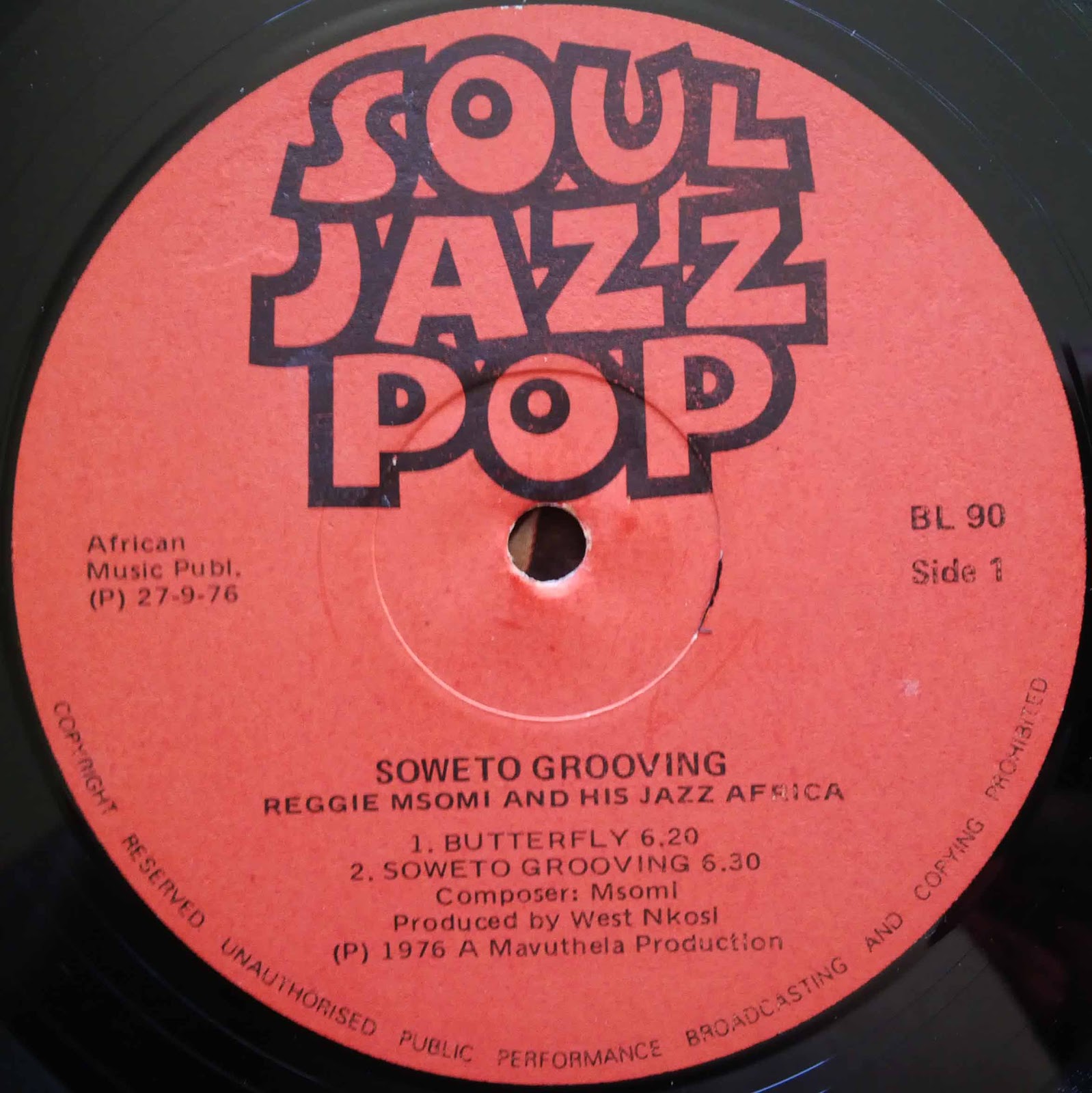
Reggie Msomi: Soweto Grooving (1976)


Soweto has long been a vibrant attraction for fortune seekers from all over South Africa and further afield. Reggie Msomi and His Jazz Africa attest to a pleasing accommodation of multiple roots, most probably originally forged in the pulsating Pelican Night Club.
Soweto somehow always seems to effortlessly fuse the old and the new, the young and the old. Leaders such as Msomi and Lemmy Mabaso had been producing great music since the late 1950s, while other names appearing on this album were yet to become famous – for example guitarist and singer Ray Chikapa Phiri went on to form “Stimela”.

“On first alto sax Lemmy Special Mabaso from Diepkloof Johannesburg; on tenor sax Aubrey Simani from Meadowlands Johannesburg; on baritone sax Freeman Lombatha from East London, Eastern Cape; on tenor and guitar Reggie Msomi from Port Shepstone, Natal; on lead guitar Chikapa Phiri from Nelspruit, Eastern Transvaal; on bass guitar Richard Shongwe from Nelspruit; on drums Isaac Mtshali also from Nelspruit.” (from the sleeve notes).

If you have not heard the other great Reggie Msomi offerings on Electric Jive, do yourself a favour and use the ”SEARCH” function on the right hand column of this blog:

Recorded at the EMI Studios in Johannesburg on 27th September 1976.
Recording Engineer; Glen Pearce
Produced by West Nkosi
Soul Jazz Pop BL90

All tracks composed by Reggie Msomi

1. Butterfly (6:20)
2. Soweto Grooving (6:30)
3. Lovers Party (6:00)
4. Nomndayi (7:00)

Rapidshare here
Mediafire here

Monday, 30 January 2012

Spokes Mashiyane - Spokes Hit Parade No. 1 (1962)


Next week marks 40 years since the untimely death of Spokes Mashiyane at the age of 39. The South African legend died of cirrhosis of the liver on February 9th, 1972 at Baragwanath Hospital in Soweto. Significantly last week marked the 79th anniversary of his birth. On this occasion it seems fitting to present two very rare issues by the renowned penny whistler and saxophonist — one (pictured above) released 50 years ago and the other perhaps his last recording.

An extensive discography for Spokes Mashiyane has been compiled in conjunction with this post and can be viewed at flatint. Many thanks to the team here at Electric Jive for help with that and also to Laurent Dalmasso who suggested the idea for this post.

Willard Cele introduced pennywhistle jive or what would later become known as kwela to South African audiences in the classic 1951 film The Magic Garden. Remarkably the commercial potential of this music was not evident and thus was not exploited by the record companies at the time. Subsequently no other recordings of this music were made until three years later with a track by the Orlando Tin Whistlers. (Rob Allingham in Lara Allen, Circuits of Recognition…)

But it was Johannes 'Spokes' Mashiyane — more than any other — who would popularise this style of music and transform it into a household name starting with four tracks recorded for Trutone on October 8, 1954. One of those, Ace Blues, became a hit, and by 1955 was receiving favorable reviews in the black press. Soon every record company in South Africa was looking to capitalize on an instrument that had been regarded as a mere toy relegated to the rural life of young herd boys.

Of course the instrument’s history is more complex and elements of its 20th century use can be traced back to Scottish marching bands of the 1920s. Lara Allen’s excellent article Circuits of Recognition… elaborates on this subject in great detail and is well worth the read.

Spokes Mashiyane was born in Vlakfontein near Pretoria on January 20th 1933. According to the liner notes of his first Trutone EP, Mashiyane taught himself to play on a reed flute while tending his father’s cattle. Albert Ralulimi in an interview with Lara Allen reveals that Spokes first played on a plastic toy penny whistle before moving on to a metal one. When he was eighteen, Mashiyane moved to Johannesburg where he met Frans Pilane with whom he formed a duo. Together the two busked with flute and guitar on street corners and in parks. Ralulimi goes on to say that Mashiyane's style at the time improvised on grassroots tunes played by "anybody" - the community in general, kids on street corners, and those at shebeens and stokvel gatherings.

It was on one such occasion at Zoo Lake Park (Yvonne Huskisson has it at Phomolong Train Station) that the duo was spotted by Trutone producer and talent scout Strike Vilakazi. According to Rob Allingham, Vilakazi cut at least four tracks with them in 1954: Ace Blues (4080) Kwela Spokes (4081), Skokiaan (4082) and Meva (4083). Huskisson, on the other hand, does suggest that Mashiyane’s first recordings were made in 1949. He would have been sixteen at the time and given that Allen’s account has him moving to Johannesburg when he was eighteen, the earlier recordings may be unlikely.

While penny whistle recordings were popular amongst black consumers in South Africa between 1954 and 1958, two events in 1958 helped propel this style of music onto the international stage and subsequently elevated its stature with white consumers, as Lara Allen points out. One was the UK television show, The Killing Stones, which featured as its theme Elias Lerole’s Tom Hark (Columbia YE 164); and the other was the recording of Spokes Mashiyane and touring American bop pianist Claude Williamson.

In April 1958, Trutone arranged for a collaborative recording with Mashiyane and the Claude Williamson Trio who were touring the country with Bud Shank as the “Jazz West Coast No. 3” at the time. The concert took place at the Bantu Men’s Social Centre (BMSC) and the live recording produced at least two tracks with Mashiyane, Kwela Claude and Sheshisa!

While EMI did well marketing Tom Hark, Trutone did a better job of further branding Mashiyane by exploiting the American connection with the Claude Williamson Trio and transforming him into an “instant celebrity”.

Allen goes on to say: “Trutone's aggressive marketing included billing Mashiyane as 'King Kwela', and printing his picture on record labels; it was the first time a South African record company had lavished such extensive publicity on a black musician. Although it was unprecedented to print comments on record labels of 78s aimed at black consumers, the "Kwela Claude" label declares: "The famous American pianist CLAUDE WILLIAMSON, says: "The Kwela Rhythm, born in the craddle of jazz, is unlike any other I have played. It could well take its place alongside Calypso and the Samba.""" (Allen)

Such successful marketing certainly helped raise the prestige of kwela and Mashiyane at the time. Trutone issued copies of Kwela Claude not only on its Quality label but also on its Rave label. This is significant in South Africa in that Quality records were typically marketed to black consumers while Rave records were marketed to white consumers. The EP Kwela Claude (Rave, REP 4) is the first to feature a black artist in such a significant profile on a Rave release.

Likewise Mashiyane’s first full-length album, King Kwela (Rave, RMG 1107), issued around 1958 or 1959, became the first long-playing record to feature exclusively a single black artist. Most recordings by black musicians until that point were issued on 78 rpm. If black music appeared on compilation LPs, it was usually marketed to white consumers or intended for international export. Issued on the Trutone’s Rave label, it is likely that King Kwela was also being marketed in this way. Though a full length LP, King Kwela is still a compilation of previously issued 78 rpm tracks.

1958 also marked another watershed moment in Mashiyane’s brilliant career. Trutone producer Strike Vilakazi persuaded Mashiyane to take up the saxophone and apply his penny whistle techniques to the instrument. Big Joe Special (Quality, TJ 500) recorded that year, was one of the early results of the saxophone experiment. As with his earlier Ace Blues, Big Joe Special was a sales phenomenon. The record became the trendsetting hit of that year and would inspire a whole new style of music. Sax jive — latter called mbaqanga — would dominate South African urban music for the next twenty years. In many ways this track marks the beginning of the eventual decline of not only the majuba big band jazz era (see Majuba Jazz on Electric Jive) but also penny whistle kwela itself. Younger consumers were looking for faster, heavier sounds and mbaqanga would soon satisfy those desires.

Trutone’s success with Mashiyane was extremely lucrative for the company, yet they continued to pay Mashiyane a flat fee for his recordings ranging from seven to fifty dollars per record. David Coplan mentions that after Mashiyane pressed the company on royalties he was assaulted by thugs. It is no surprise then that the musician was subsequently lured away by Gallo Records in 1958. Under a deal brokered by Union Artists with Gallo, Mashiyane became the first black musician in South Africa to receive royalties from his recordings.

Gallo picked up where Trutone left off and continued the extensive marketing of Mashiyane. Gallo’s New Sound label, with whom Mashiyane was recording, donned their all-to-familiar record sleeves with his image and a listing advertising his other recordings. View Chris Albertyn's two posts on some of the New Sound 78 rpm recordings here and here at Electric Jive.

In 1959 another full-length album Spokes of Africa was issued. Mashiyane's second, this LP to my knowledge was also the second for any black artist. Gallo’s New Sound label then launched an excellent series of LP records around late 1959 or early 1960. The first being New Sounds of Africa (NSL 1001) a compilation LP with Mashiyane, Miriam Makeba and the Skylarks but almost exclusively featured tracks by Mashiyane. This series would go on to included the classic 1962 Castle lager Jazz Festival (NSL 1010) and the highly acclaimed and collectable Chris McGregor and his Castle Lager Big Band (NSL 1011). Of the eight LPs that I am familiar with from this series, Mashiyane appears on four and it is his Spokes Hit Parade No.1 (NSL 1009) that we feature on Electric Jive today. (Thanks to Sean Conlon for trading this into the flatinternational archive.)

The Gallo NEW SOUND Series:

NSL 1001 - New Sounds of Africa Vol. 1 (c1960)
Spokes Mashiyane with Miriam Makeba and the Skylarks
NSL 1002 - New Sounds of Africa Vol. 2 (c1960)
Spokes Mashiyane with Miriam Makeba and the Skylarks
NSL 1006 - Top Hits of the Big Three - New Sound Vol. 4 (c1961)
Spokes Mashiyane, Reggie Msomi and Lemmy Mabaso
NSL 1007 – Twisting with Reggie Msomi (1962)
Reggie Msomi
NSL 1008 – Lemmy Hit Parade No. 1 (1962)
Lemmy Mabaso
NSL 1009 - Spokes Hit Parade No. 1 (1962)
Spokes Mashiyane
NSL 1010 – 1962 Cold Castle National Jazz Festival (1962)
Various Artists
NSL 1011 – Jazz: The African Sound (1963)
Chris McGregor and the Castle Lager Big Band

Mashiyane continued recording with Gallo throughout the early to mid 1960s. In July of 1965 he was invited to appear at the Newport Folk Festival in the United States where he “stole the show” according to the sleeve notes of his US issued LP, (King Kwela) (London, TW 91408). An August 7, 1965 article in Billboard Magazine remarks that "Spokes Mashiyane, from Johannesburg, South Africa, was an unscheduled treat. His swingy beat and flute captured the audience. He was the unexpected highlight of the Saturday night concert."

Murray Lerner’s film Festival documents the concert and includes footage of Mashiyane's performance. Watch a clip here. Note that Mashiyane is not the first performer but comes in towards the end of this clip at around 7 mins and 40 secs.

A number of Mashiyane recordings post-Newport reference his US visit, for example the tracks 5th Avenue and New York City (New Sound, GB 3617) not to mention New Port and America on his final LP.

Though Mashiyane is present at the birth of Gallo’s Mavuthela, his recordings for Gallo appear to taper off towards the later half of the 1960s. It is not clear to me why, but I suspect that the success of the hard-mbaqanga sound produced by Mavuthela during this period might have contributed to what appears to be a waning interest in Mashiyane.

Interestingly a 1969 compilation LP, the Golden City Album does include a mbaqanga styled sax jive by Mashyiane. The track is noticeable for two reasons: one, the title “The Return of Spokes” suggests an absence, and two the record is issued by Trutone not Gallo. Perhaps the “Return of Spokes” has a double meaning here, and could be interpreted in one of two ways: he is returning to recording or he is returning to Trutone. A recording with Trutone does suggest a break with Gallo. Moreover his next LP King of the Penny Whistle was produced by David Thekwane and issued by Teal Records.


Released on Teal’s Star Black label (SKL 3000) (their first I believe) in 1969, Mashiyane here returns to the penny whistle, which for that time seems particularly unusual. The popularity of kwela had been waning since the late 1950s and with the rise of mbaqanga in the 1960s, it seemed that the style of music had all but been abandoned. Mashiyane here revisits in name at least some of his big hits like Ace Blues and TJ 500, the catalogue number for his first sax hit Big Joe Special. Surprisingly, he is backed by a band boasting a full elastic mbaqanga sound. My guess is that this is Mashiyane’s last album. It is also the second we are sharing today.

To view an extensive discography for Spokes Mashiyane visit flatint.

Enjoy!

SPOKES HIT PARADE NO. 1
1962
New Sound
NSL 1009


KING OF THE PENNY WHISTLE
1969
Star Black
SKL 3000

Monday, 2 June 2014

Sax Jive Special - Vol. 2

We're keeping this instrumental theme going for just a little bit longer here on Electric Jive. Why? Well, why not?! Sax jive happens to be one of the most peppy and sweet styles of instrumental dance music that has ever existed - and what better way of celebrating the genre than sharing with our readers another bumper collection of the very best sax jives? Following on from our last delve into the archives, we present to you Sax Jive Special - Vol. 2.

The Makgona Tsohle Band were the first guys on the scene in the 1960s to take the swing-style instrumental jive and reshape it into the more danceable, more electric and elastic mbaqanga beat which soared to amazing heights. If just one listen to real gems like "Umzinto", "Cowboy" or "Sithunyiwe Thokozile" doesn't at the very least get your foot tapping, then there's something truly wrong with your musical tastes. Under various recording pseudonyms, the men behind the Makgona Tsohle Band created the biggest instrumental hits of the day. That team - Marks Mankwane on lead guitar, Vivian Ngubane on rhythm guitar, Joseph Makwela on bass, Lucky Monama on drums and West Nkosi leading on alto saxophone - was the gold standard, the benchmark against which all other mbaqanga bands were measured.

The Makgona Tsohle Band didn't just back West - they were the Mavuthela house band who generally backed every one of the stable's saxophone players and vocal jive groups. Lemmy 'Special' Mabaso shot to fame as the child pennywhistler of the late 1950s - but by the 1960s, with kwela out and mbaqanga in, he turned to the alto sax and joined forces with Makgona Tsohle for a series of recordings that included "Sipho Special". You can clearly hear everyone in the studio feeding off each other's high spirits on this bouncy number.

Spokes Mashiyane, the man who brought sax jive to prominence, also joined forces with Mavuthela during the 1960s. It might be true to say that the great Mashiyane became sidelined and unappreciated as the style developed further and further into the more hard and bouncy mbaqanga, with the spotlight focusing instead on fresh young talent like West Nkosi, David Thekwane, Reggie Msomi, Boy Masaka and others. Mashiyane did continue to record sporadically though and did create some great sax jives with the Makgona Tsohle Band, such as "Kgwale". "Sediba" is also an enjoyable tune featuring Mashiyane on top form. The real star here though is Vivian Ngubane who bends the melody fantastically with his rhythm guitar. Ngubane, for some rather puzzling reason, seems to be generally forgotten compared to those he worked with such as Marks Mankwane and Joseph Makwela. This is all the more strange because Ngubane was nothing less than a trendsetter. His rhythm guitar, sandwiched between Mankwane's lead guitar and Makwela's bass, became the signature elastic bedrock of the music. Until Ngubane joined the Makgona Tsohle Band late in 1964, the rhythm guitar line was still being filled by an acoustic guitar player who strummed nothing more than simple chords. Ngubane's trademark sound opens "Umzinto", a good example of the staple instrumental mbaqanga that Makgona Tsohle pumped out of the Gallo studio every week.

Sipho Bhengu, before joining the famous Mango Groove and lending them his wonderful talents, was a supreme sax jive star of the 1970s. His "Welani Imifula" opens with a boisterous spoken word from Mavuthela's boss Rupert Bopape and then gives way to the musical backing of the Jets and Sipho's great sax rhythms. Another sax jive star was Selby Mmutung - better known to you and me as Bra Sello. Sello made his name playing with Abafana Bentuthuko and later joined Mavuthela, working with the late genius Mzwandile David to produce sax-accordion jives under the name Mathwalimbuzi. "Umsuzo" rather bizarrely refers to someone breaking wind and Sello certainly creates the right impression during the opening of the tune. Reggie Msomi was also a talented somebody. During the 1960s, Msomi and his Hollywood Jazz Band (usually comprising Reggie on sax backed by the talented Makgona Tsohle Band!) produced some rather adventurous instrumental hits - taking sax jive and mixing it with various other styles such as soul, ska or reggae. "Chumba" is a great tune with some hints of Congo rumba. Aaron Jack Lerole also turned and twisted sax jive and took it to newer heights. "Space Age" is simply amazing - just listen and hear for yourself.

The marvellous Zwino Zwino Boys, led by bass guitarist James Mukwevho, bring our compilation to a fitting close with the excellent "Thala Thala". This has to be one of my favourite sax jives of all time. Sam Jagome effortlessly kicks everything off with a few calm strums of his electric lead guitar. The rest of the band joins in and this combined force works up some truly magical rhythms. The late Sam has to be one of the forgotten geniuses of mbaqanga music. He followed Marks Mankwane's unique innovations and ended up creating a signature style all of his own. Sam's beautiful lead guitar strains could be heard not only in the Zwino Zwino Boys but also behind the spirited vocals of Izintombi Zomoya.

Our thanks to Laurent Dalmasso for contributing two wonderful tracks to this compilation from the original 78 rpm discs - "Sediba" and "Sipho Special". All you need to do now is download this mix and get yourself ready for some serious jiving until you drop.

ENJOY!

SAX JIVE SPECIAL - VOL. 2

01) PAKU PAKU - MAKHOLOKHOLO (1965)
02) SEDIBA - SPOKES AND HIS GOLDEN SAX (1966)
03) UMZINTO - LUCKY MONAMA AND HIS PARTNERS (1968)
04) CHUMBA - REGGIE MSOMI AND HIS HOLLYWOOD JAZZ BAND (1969)
05) SIPHO SPECIAL - LEMMY MABASO AND HIS SAX (1965)
06) JIVE SMODERN JIVE - MAKHOLOKHOLO (1965)
07) COWBOY - WEST NKOSI AND HIS SAX (1967)
08) TADIMA TADIMA - ZWINO ZWINO BOYS (1971)
09) WELANI IMIFULA - SIPHO BHENGU AND HIS JETS (1973)
10) MANYANE JIVE PART TWO - POPS AND SONS (1976)
11) PULL MAN NO. 2 - MARKS AND THE SHALUZA BOYS (1976)
12) UMSUZO - MATHWALIMBUZI (1976)
13) BATHATHE GEORGE - ABAKHWENYANA (1973)
14) KIT BAG - MAMBAZA NABAFANA BOMSHOSHOLOZO (1971)
15) FOUR MABONE - WEST NKOSI NABASHOKOBEZI (1973)
16) AMANZI AMANCANE NO. 5 - LUCKY MONAMA AND HIS PARTNERS (1971)
17) SITHUNYIWE THOKOZILE - MAKGOLOKGOLO (1967)
18) KGWALE - SPOKES AND HIS GOLDEN SAX (1967)
19) SPACE AGE - BIG VOICE JACK (1971)
20) THALA THALA - ZWINO ZWINO BOYS (1971)

Tuesday, 6 July 2010

Kwela going global: “Spokes of Africa” keeps inspiring


This Spokes Mashiyane rarity goes out to Donpiper and the pennywhistle music-makers and keepers at the schiff and fipple forum, as well as Chris in the UK who runs a fantastic “kwela” blogsite project because:
 “The pennywhistle is a fantastic instrument; expressive, cheap, portable, quick to get started. However its versatility is perceived to be limited due to its almost-exclusive association with celtic music. Kwela challenges this preconception and introduces those who haven’t heard it to a new way of hearing and playing the pennywhistle.”

This small group of good people from all around the world have got themselves together and are doing things like developing and sharing transcriptions and information on kwela and pennywhistle music so they too can keep performing and playing it. Now that is really keeping the music alive!

On this album Spokes introduces and then plays a velvety smooth rendition of Kwela Kong, and follows up with another called “Little Kwela Kong” which would also have fitted just as perfectly in that fine musical. He also teams up in a duet with Lemmy Mabaso to deliver Manyatela.

Thanks again to Siemon for sharing this rare album – there is one copy available on the net right now … the starting price is $300 U.S.. Enjoy.
APOLOGIES for the delays - rapidshare keeps dropping half way through
RS here
MF

Thursday, 5 February 2015

She's Gone: The Flaming Souls (1968)


James Brown certainly reached South Africa – and is found reflected in this recording in the mood, energy and Philip Mallela’s vocals to match! It really is a thrill for me to share this gem of a recording with you today, the Flaming Souls’ debut album – thanks to Electric Jive visitor and Facebook friend Kataquomb Braka for sharing. Note: a new mint copy of the album has found its way to me and has now been digitised. If you downloaded the previous version with the skip in "She's Gone" - try the new version available from the link at the bottom of this post.

Band-leader Simon Jika Twala
One flame that adds impetus to Electric Jive’s archiving energies is always the potential that someone  is going to pop up and say, “hey, did you know about this one?”

Alexandra Township – also known as Dark City – has been the fountain from which many of South Africa’s musical legends have emerged: The Piliso brothers, Zacks Nkosi, Lemmy Mabaso, Caiphus Semenya, and then as the root of soul, starting with “The Anchors” – check them out here.  The Movers also hailed from Alex.
Writing in the Sowetan newspaper (2nd November, 2012) on the occasion of band-leader  Simon "Jika" Twala’s passing, Victor Mecoamere records that this here album sold 75,000 copies in South Africa. It is further documented that the Flaming Souls played an important community building role in Alexandra, raising funds to improve local schools and clinics.

Follow-up albums are reported as “Soul Time” and “Alex Stew”. Electric Jive does have “Alex Soul Menu” which you can find hereDoes anyone out there have any other recordings?

You can  find “Soul Time” with the Flaming Souls over at Soul Safari - here

And if you have not heard it yet – “Soul Bandit” from Almon Memela’s AM Stragglers is another important milestone in this genre - here


From Ray Nkwe’s liner notes:
“It was nearly one Sunday morning when I arrived home from a whole-night jazz gig exhausted and tired and all that jazz. I asked my wife not to disturb me while I took a nap. When I work up late that afternoon she told me that The Flaming Souls had been to see me, but they did not want to disturb me while I was resting. Without saying a word I called out for my daughter, but instead of her answering to the call, her mother said “SHE’s GONE”.

“What do you mean she’s gone?”, I asked.

“Well, she left with The Flaming Souls. You know she’s in love with The Souls, now she’s gone with them to Mafolo Hall for an afternoon show,” was her answer.

“Oh I dig baby, I dig. So my girl is gone with The Flaming Souls.” I said. “I’ll see that something is done about it.”

After  a few days I met Herman Fox, The Soul’s lead guitarist. I told him what had happened the Sunday when they went to Mafolo Hall via my house, and the answer I got from my wife when I called my daughter. He laughed.

“She’s gone”, he repeated. “Well soul brother, I shall surely write a song about that. “She’s gone”, and I am sure you’ll like it,” he said.

That was the birth of this outstanding album by the Fabulous Flaming Souls. The first non-white group of southern African that introduced Soul Music in LIVE PERFORMANCES. So they can easily be referred to as Pioneers of Soul.

About the music. Surely you can feel its SOULFULNESS yet MELLONESS. Take a song like SOUL WORLD,  more especially when she’s gone. This time not my daughter but the one you so dearly LOVE. Then we move to the outskirts of town, Mexico. There we meet women in colourful dresses and men with big sombreros, dancing to the soulful music played on guitars and bongo drums. How sweet SACRAMENTO is.

About the music makers.  In the year 1964, a young man by the name of Simon Twala had a brainwave which resulted in the formation of a group called The Anchors, whose members were six other Alexandra Township lads, Herman Fox, Ezrom Kgomo, Phillip Malela, Abram Rapoo, Gerard Khoza, and Collins Mashigo.

The group played together for four years and then there was a split. Simon then formed the now known Flaming Souls. These Fabulous Flaming Souls were formed in February 1968 and, Oh Boy ... since then soul has been the talk of the town. In other words Alexandra Township is the home of soul greats a la South Africa. Today, the whole country is full of soul groups.

Ray Nkwe
President, Jazz Appreciation Society of South Africa.
Cover photo: Alf Khumalo
Liner Photos: Dave Diale
Producer: Ray Nkwe
Recorded 2nd and 10th June 1969 at the Johannesburg studios of Audio Kine Africa.

Simon Twala - Leader/ Bass Guitar; Gerard Khoza - Organ & Drums; Kenneth Mosito - Organ; Herman Fox - Lead  Guitar; Phillip Mallela – Vocals & Drums.
Mediafire NEW CLEAN download here