Showing posts with label west nkosi. Show all posts

Tuesday, 20 September 2016

The Sherbone Stars - Nokuzola (1979)

We continue our exploration of the fields of 1970s soul and disco. Today's LP is Nokuzola, released in 1979 on the Ziya Duma label and produced by the legendary West Nkosi. The album features 12 disco-soul-jive numbers by The Sherbone Stars and The Peddlars. While not much can be said about the seminal Peddlars that regular readers don't already know, you may be wondering who The Sherbone Stars are. The ladies - Joana Thango from Kwa Nongoma, Catherine Dumakude from White City Jabavu, Helen Mosolodi from Sibasa and Sandra Senne from Rustenburg - are the unknown voices you can hear harmonising on most of Mpharanyana's recordings made with The Peddlars between 1978 and 1979. The composer credits indicate the presence of session player Meshack Mkhwanazi and the LP itself includes some lead vocals from other freelancers including Albert Motha, Mahotella Queens vocalist Thandi Radebe and Jacob Khoza. Mpharanyana Radebe only appears on one number here - "Ngiyizwile Inyoni" - but there are Zulu language versions of songs from his album Morena Re Thuse Kaofela (Soul Jazz Pop BL 173). Both Meshack Mkhwanazi and The Sherbone Stars were shepherded by West on a variety of studio productions including the aforementioned Morena Re Thuse Kaofela, Patience Africa's hit albums Siyabonga (Soul Jazz Pop BL 175) and Let's Groove Tonight (Black Hi-Lights Records BL 245) and a number of recordings by Venda group Takalani Band, shared here on Afrosynth. Both Meshack and fellow musician Albert Motha were recruited by West into a new mbaqanga group later in 1979 - Amaswazi Emvelo.

Enjoy!


THE SHERBONE STARS
NOKUZOLA
produced by West Nkosi
Ziya Duma BL 174
1979
Zulu and English Vocal

MF

Tuesday, 26 August 2014

Boyoyo "900" Umjiko Wamarabi (1973)

As summer comes to an end in the north, we feature an exciting early 70s compilation on the Trutone label. Strangely, none of the artists are credited on the cover, but the composer notes do reveal some of the best from Gallo — Marks Mankwane, Lucky Monama, West Nkosi and others — playing an eclectic array of mbaqanga instrumentals on sax, concertina and organ.

Thomas Phale’s first major hit with the T-Bones was “Boyoyo” in 1972. The title also happened to be the nick-name of the group's first drummer. The track was so successful the group decided to change their name permanently to the Boyoyo Boys. Issued in February 1973, the Trutone LP featured today, is clearly riding the wave of the "Boyoyo" phenomenon. Nevertheless I am not sure if any of the Boyoyo Boys are featured here.

Watch this space for some more comprehensive archival material coming soon!

Boyoyo "900" Umjiko Wamarabi
Trutone
MSLP 502
(1973)

Monday, 2 June 2014

Sax Jive Special - Vol. 2

We're keeping this instrumental theme going for just a little bit longer here on Electric Jive. Why? Well, why not?! Sax jive happens to be one of the most peppy and sweet styles of instrumental dance music that has ever existed - and what better way of celebrating the genre than sharing with our readers another bumper collection of the very best sax jives? Following on from our last delve into the archives, we present to you Sax Jive Special - Vol. 2.

The Makgona Tsohle Band were the first guys on the scene in the 1960s to take the swing-style instrumental jive and reshape it into the more danceable, more electric and elastic mbaqanga beat which soared to amazing heights. If just one listen to real gems like "Umzinto", "Cowboy" or "Sithunyiwe Thokozile" doesn't at the very least get your foot tapping, then there's something truly wrong with your musical tastes. Under various recording pseudonyms, the men behind the Makgona Tsohle Band created the biggest instrumental hits of the day. That team - Marks Mankwane on lead guitar, Vivian Ngubane on rhythm guitar, Joseph Makwela on bass, Lucky Monama on drums and West Nkosi leading on alto saxophone - was the gold standard, the benchmark against which all other mbaqanga bands were measured.

The Makgona Tsohle Band didn't just back West - they were the Mavuthela house band who generally backed every one of the stable's saxophone players and vocal jive groups. Lemmy 'Special' Mabaso shot to fame as the child pennywhistler of the late 1950s - but by the 1960s, with kwela out and mbaqanga in, he turned to the alto sax and joined forces with Makgona Tsohle for a series of recordings that included "Sipho Special". You can clearly hear everyone in the studio feeding off each other's high spirits on this bouncy number.

Spokes Mashiyane, the man who brought sax jive to prominence, also joined forces with Mavuthela during the 1960s. It might be true to say that the great Mashiyane became sidelined and unappreciated as the style developed further and further into the more hard and bouncy mbaqanga, with the spotlight focusing instead on fresh young talent like West Nkosi, David Thekwane, Reggie Msomi, Boy Masaka and others. Mashiyane did continue to record sporadically though and did create some great sax jives with the Makgona Tsohle Band, such as "Kgwale". "Sediba" is also an enjoyable tune featuring Mashiyane on top form. The real star here though is Vivian Ngubane who bends the melody fantastically with his rhythm guitar. Ngubane, for some rather puzzling reason, seems to be generally forgotten compared to those he worked with such as Marks Mankwane and Joseph Makwela. This is all the more strange because Ngubane was nothing less than a trendsetter. His rhythm guitar, sandwiched between Mankwane's lead guitar and Makwela's bass, became the signature elastic bedrock of the music. Until Ngubane joined the Makgona Tsohle Band late in 1964, the rhythm guitar line was still being filled by an acoustic guitar player who strummed nothing more than simple chords. Ngubane's trademark sound opens "Umzinto", a good example of the staple instrumental mbaqanga that Makgona Tsohle pumped out of the Gallo studio every week.

Sipho Bhengu, before joining the famous Mango Groove and lending them his wonderful talents, was a supreme sax jive star of the 1970s. His "Welani Imifula" opens with a boisterous spoken word from Mavuthela's boss Rupert Bopape and then gives way to the musical backing of the Jets and Sipho's great sax rhythms. Another sax jive star was Selby Mmutung - better known to you and me as Bra Sello. Sello made his name playing with Abafana Bentuthuko and later joined Mavuthela, working with the late genius Mzwandile David to produce sax-accordion jives under the name Mathwalimbuzi. "Umsuzo" rather bizarrely refers to someone breaking wind and Sello certainly creates the right impression during the opening of the tune. Reggie Msomi was also a talented somebody. During the 1960s, Msomi and his Hollywood Jazz Band (usually comprising Reggie on sax backed by the talented Makgona Tsohle Band!) produced some rather adventurous instrumental hits - taking sax jive and mixing it with various other styles such as soul, ska or reggae. "Chumba" is a great tune with some hints of Congo rumba. Aaron Jack Lerole also turned and twisted sax jive and took it to newer heights. "Space Age" is simply amazing - just listen and hear for yourself.

The marvellous Zwino Zwino Boys, led by bass guitarist James Mukwevho, bring our compilation to a fitting close with the excellent "Thala Thala". This has to be one of my favourite sax jives of all time. Sam Jagome effortlessly kicks everything off with a few calm strums of his electric lead guitar. The rest of the band joins in and this combined force works up some truly magical rhythms. The late Sam has to be one of the forgotten geniuses of mbaqanga music. He followed Marks Mankwane's unique innovations and ended up creating a signature style all of his own. Sam's beautiful lead guitar strains could be heard not only in the Zwino Zwino Boys but also behind the spirited vocals of Izintombi Zomoya.

Our thanks to Laurent Dalmasso for contributing two wonderful tracks to this compilation from the original 78 rpm discs - "Sediba" and "Sipho Special". All you need to do now is download this mix and get yourself ready for some serious jiving until you drop.

ENJOY!

SAX JIVE SPECIAL - VOL. 2

01) PAKU PAKU - MAKHOLOKHOLO (1965)
02) SEDIBA - SPOKES AND HIS GOLDEN SAX (1966)
03) UMZINTO - LUCKY MONAMA AND HIS PARTNERS (1968)
04) CHUMBA - REGGIE MSOMI AND HIS HOLLYWOOD JAZZ BAND (1969)
05) SIPHO SPECIAL - LEMMY MABASO AND HIS SAX (1965)
06) JIVE SMODERN JIVE - MAKHOLOKHOLO (1965)
07) COWBOY - WEST NKOSI AND HIS SAX (1967)
08) TADIMA TADIMA - ZWINO ZWINO BOYS (1971)
09) WELANI IMIFULA - SIPHO BHENGU AND HIS JETS (1973)
10) MANYANE JIVE PART TWO - POPS AND SONS (1976)
11) PULL MAN NO. 2 - MARKS AND THE SHALUZA BOYS (1976)
12) UMSUZO - MATHWALIMBUZI (1976)
13) BATHATHE GEORGE - ABAKHWENYANA (1973)
14) KIT BAG - MAMBAZA NABAFANA BOMSHOSHOLOZO (1971)
15) FOUR MABONE - WEST NKOSI NABASHOKOBEZI (1973)
16) AMANZI AMANCANE NO. 5 - LUCKY MONAMA AND HIS PARTNERS (1971)
17) SITHUNYIWE THOKOZILE - MAKGOLOKGOLO (1967)
18) KGWALE - SPOKES AND HIS GOLDEN SAX (1967)
19) SPACE AGE - BIG VOICE JACK (1971)
20) THALA THALA - ZWINO ZWINO BOYS (1971)

Monday, 7 April 2014

Nelcy Sedibe - Sengaliwe (1984)

Today we present a great LP from the Electric Jive archives. Sengaliwe, solo artist Nelcy Sedibe’s first album, was released in 1984 on the Soul Jazz Pop label.

From the liner notes on the back cover:

Nelcy Sedibe was born in 1957 at Barberton in the Eastern Transvaal. She did her primary schooling at Mganduzweni, from there to Masoyi Higher Primary to do Standard 5 and eventually went on to complete Form 2 at Mshadza High in 1977.

Nelcy started her singing career at the age of eight, singing for Sunday School. She also participated in school choirs. When she left school she went to work as a beautician. During those years she kept up her interest in music and joined a band called KAKAI. In 1980 Nelcy decided to go to Johannesburg to pursue her career in music. She had a strong belief in herself and was positive that she could break into the music world and become the best female vocalist in South Africa.

In Johannesburg she met Mr Mojapelo, Kori Moraba’s manager. He put her into Kori’s group as a vocalist. Together with Kori she toured the country gaining valuable experience performing in live shows, but she still wanted to be a solo singer and felt that this was not what she was looking for. Nelcy eventually met with producer West Nkosi who signed her to his record company. Co-incidentally, the group that backed Nelcy on her first recordings was KAKAI – and from here it was smooth sailing.

Back in her home town of Barberton, Nelcy rehearsed for almost a year before recording. During this time West Nkosi sent her a cassette to guide her in the style of music that she should be singing and recording. Nelcy began to feel that all her dreams were coming true. In April 1983, Nelcy received the news that she was to go to Johannesburg to record – she was delighted. She recorded a Maxi seven single which was aimed specifically at the Zulu Nation. She wrote her own music and lyrics for “KIKIZELANI” and West gave her some tunes like “SENGIZULA NEZWE”.

For Nelcy things have only just begun – and the sky is the limit.

Nelcy's song "Holotelani", the original Swazi-language version of "Kikizelani", was included on the groundbreaking 1985 compilation The Indestructible Beat of Soweto. The great singer has since passed on but her magical voice can still be heard through the numerous recordings she made - and this album is a real gem. Enjoy!


NELCY SEDIBE
SENGALIWE
produced by West Nkosi
Soul Jazz Pop BL 470
1984
Zulu Vocal

RS / MF

Friday, 3 May 2013

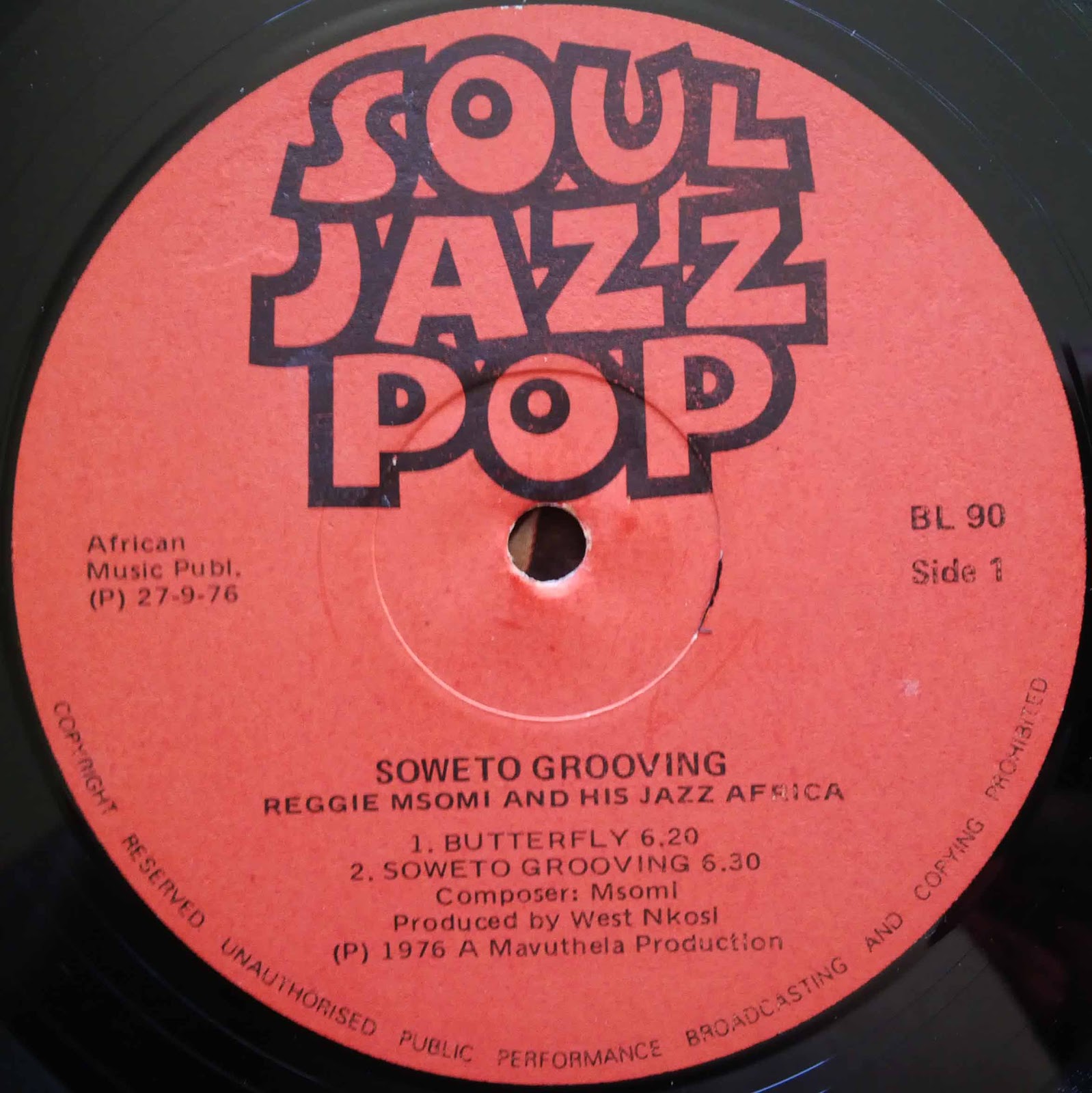
Reggie Msomi: Soweto Grooving (1976)


Soweto has long been a vibrant attraction for fortune seekers from all over South Africa and further afield. Reggie Msomi and His Jazz Africa attest to a pleasing accommodation of multiple roots, most probably originally forged in the pulsating Pelican Night Club.
Soweto somehow always seems to effortlessly fuse the old and the new, the young and the old. Leaders such as Msomi and Lemmy Mabaso had been producing great music since the late 1950s, while other names appearing on this album were yet to become famous – for example guitarist and singer Ray Chikapa Phiri went on to form “Stimela”.

“On first alto sax Lemmy Special Mabaso from Diepkloof Johannesburg; on tenor sax Aubrey Simani from Meadowlands Johannesburg; on baritone sax Freeman Lombatha from East London, Eastern Cape; on tenor and guitar Reggie Msomi from Port Shepstone, Natal; on lead guitar Chikapa Phiri from Nelspruit, Eastern Transvaal; on bass guitar Richard Shongwe from Nelspruit; on drums Isaac Mtshali also from Nelspruit.” (from the sleeve notes).

If you have not heard the other great Reggie Msomi offerings on Electric Jive, do yourself a favour and use the ”SEARCH” function on the right hand column of this blog:

Recorded at the EMI Studios in Johannesburg on 27th September 1976.
Recording Engineer; Glen Pearce
Produced by West Nkosi
Soul Jazz Pop BL90

All tracks composed by Reggie Msomi

1. Butterfly (6:20)
2. Soweto Grooving (6:30)
3. Lovers Party (6:00)
4. Nomndayi (7:00)

Rapidshare here
Mediafire here

Monday, 3 September 2012

The Top 14 - Sax Jive & Kwela (1960 - 1964)


Today we feature a great transitional LP that sits somewhere between the late majuba jazz sounds of the 1950s and the very early mbaqanga perfected by the team at Mavuthela in the mid 1960s. Many of the key architects of that Mavuthela sound — West Nkosi, Reggie Msomi — are featured on this album and in some respects this album could be viewed as a precursor to the coming stylistic phenomenon.

Certainly the debt to the swing-based majuba (African Jazz) big band sounds of the 1950s is undeniable on this record. With hints of ska and swing, I would define the bulk of the tunes as "sax jives" though also included are four flute-based kwelas.  The two styles are historically linked and had been ever since Spokes Mashiyane exchanged his flute for a saxophone in 1958 and began playing sax-based kwelas. Missing from the album though is that elastic electric baseline that so typified the mbaqanga sound... and that can be heard on two slightly later compilations featured here at Electric Jive: Lets Move with Makhona Tsohle Band (1967) and Taxi Jive (c1965)

Issued in 1964, The Top 14 does appear to be GRC's first LP release on the Tempo label. The album, like many others during this time, comprised of tracks previously issued as 78 rpms with recording dates probably ranging from 1960 to 1964.

David Thekwane
This compilation includes six tunes by, saxophonist, David Thekwane — aka Velile the King — who would go on to become a major producer for Teal records in the 1970s. As a young penny whistler in Pimville, Johannesburg, Thekwane came to the attention of talent-scout Strike Vilikazi who brought him on as an assistant and salesman at Trutone Records in 1955. Thekwane's first group was the Mofolo North Stone Breakers but after taking up the alto-sax continued recording under a number of different pseudonyms including Mr. Dube, Velile the King, Baby Face, etc. On this album he performs with or as Velile the King of the Tap Steps, the TV Septet and the Black Night Hammers. According to Yvonne Huskisson, Thekwane moved to Teal as a producer in February, 1969 though Rob Allingham has it as 1972. Nevertheless one of his biggest selling groups at Teal were the iconic Movers and he was producing their records as early as 1970. Allingham also suggests that Thewane intimidated many of his musicians with physical violence — an interesting detail enhanced by Huskisson's last note that his favorite hobby was boxing.

West Nkosi also performs here under two pseudonyms — "West and Sax Boy" and Western Boys — featuring amongst others, himself and Lazarus 'Kid' Moncho.

The album also includes the track Walk to Dube by the Snqamu Jazz Band which was later reissued on the compilation: Township Swing Jazz Vol. 2 compiled by Rob Allingham. Allingham’s notes on the CD set the recording date for this particular tune as September 27, 1960 and the band personal as: Thami Madi on 1st alto, Christopher Songxaka on 2nd alto, Paul Rametsi on tenor, Jordan Bangazi on trumpet, Reggie Msomi on guitar, Saul Manikela on banjo, Johannes 'Chooks' Tshukudu on bass and Louis Molubi on drums. (With solos by Jordan Bangazi and Paul Rametsi.) Remarkably the line-up here comes closes to Spokes’ Mashiyane’s Big Five at Gallo which is not unusual considering that GRC was a subsidiary of Gallo's.

GRC itself, though initially a separate company, had a relationship with Gallo where they shared the same recording studios hence the common ABC matrix numbers. At some point the two companies would eventually merge to become Gallo - GRC.

As with issues on 78 and 45 rpm, the Tempo label on The Top 14 LP is consistent with the first design showing a trumpet on yellow and blue. In 1966 the label was sold to Trutone where the design remained the same for some issues, but was eventually redesigned with the familiar black and green pictured above.

To read the liner notes or view the track listing, check out the album here at flatinternational.

Various Artists
The Top 14
Tempo
LKT 701
issued 1964


Monday, 20 August 2012

Funny Thing: Ensemble of Rhythm and Art (1977)


Now here’s a ‘Funny Thing’ ... top-drawer musicians, whose core was no doubt drawn from Soweto’s Pelican Club House Band – playing up a funky 70s afro-jazz storm on Mavuthela’s Soul Jazz Pop label, produced by the legendary West Nkosi, but absolutely no band credits, other than to composer Simon Serakoeng aka Baba Themba Mokoena, the lead guitarist featured on Dick Khoza's "Chapita".

Themba Mokoena at the
Rainbow Restaurant, Pinetown - 2011
Take the banks of layered horns and tight rhythms from “Chapita”, the intricate keyboard and arranging sensibilities of “The Drive” and “Abacothozi,” sprinkle a little dash of “The Movers” tending only ever so slightly towards disco, put in a blender, hit the switch, and voila, you have “Ensemble of Rhythm and Art” – an 'ensemble' who seems only to have existed to produce this once-off gem of a record.

In addition to his strong afro-jazz guitar pedigree at the Pelican Club, Mokoena  is referenced as one of South Africa's finest mbaqanga guitar players by Calabash. Calabash go on to say the following:
"Simon Baba Mokoena was born at Umkumbane in Durban in the late '40. He started making music at the age of 12, playing a home-made guitar made from a five-liter oil container. At 17, he picked up his brother's acoustic guitar and has never looked back. Baba's first gig was with a group called Mhlathi and His Comets, whom he stayed with for four years. Next he met Dick Khoza, a jazz drummer. They formed a small jazz group with Pat Matshikiza on piano and Victor Gaba on bass, playing gigs around Durban.

After two years Baba left the group and went to Johannesburg to play mbaqanga, because he had always wanted to play African music. He played for a group called Izintombi Zamangwane. This was followed by guitar work on Gibson Kente's musicals Sikhalo and How Long.
Yours truly with Themba Mokoena at the
Rainbow Restaurant in Pinetown last year -
Getting an autograph on "Chapita" -
pic by Cedric Nunn
Baba joined the resident band at the Pelican Night Club, playing with Winston "Mankunku" Ngozi and Khaya Mahlangu, to name but a few. This stint at the Pelican was a chance to explore different kinds of music — mbaqanga, jazz and rhythm and blues — and to meet names like American jazz organ player Jimmy Smith and U.S. group The Realistic." Calabash go on to describe how Mokoena toured Europe with "Township Fever" and continued to enrich the music of artists such as Mbongeni Ngema and Madala Kunene.


In addition to Baba Mokoena on lead guitar, as to who else is actually’ playing on this great album, we cannot say with certainty – but the Electric Jive team members have had fun listening and tossing ideas around. We all agree, “Pelican regulars ..”. Matt and Nick are pretty sure that West Nkosi’s sax is to be heard, along with Dennis Mpale’s trumpet. Nick wonders about one or both the Piliso brothers, pointing out they were “certainly very active in soul-jazz-pop sessions at the time"? Anyone have any other suggestions?

 For those album cover lovers among you – another Zulu Bidi artwork – see and listen also here for "Night at Pelican". As the ace bass player for Batsumi, Zulu Bidi also did the Batsumi cover, at least two for the Makhona Zonke Band, and one Mpharanyana and the Cannibals (Zion), as well as this 1975 “Reggae Man” cover.

Matt has put up excerpts from the BBC doccie on Zulu Bidi here - “Life and Death in Soweto” here.

Funny Thing: Ensemble of Rhythm and Art
Soul-Jazz-Pop BL110
Recorded 25th July 1977.
Produced by West Nkosi
Engineer: Glen Pearce
 
Side 1
The Dustbin
Funny Thing
Side 2
Pelican Fantasy
Hello There

Rapidshare here
Mediafire here

Monday, 14 May 2012

Jump and Jive with West Nkosi (1967)

Today we feature the very first “solo” long playing record by the legendary saxophonist, composer, producer and, later, executive for Gallo records — West Nkosi — a major figure in the South African recording industry for more than three decades.

As a member of the famed Makhona Tsohle Band in the early 1960s, Nkosi help develop the sound of sax jive and subsequently the style of mbaqanga. As a producer he signed and recorded classic groups like Ladysmith Black Mambazo as well as Mahlathini and the Mahotella Queens.

Jump and Jive with West Nkosi, completes what I like to call the early Mavuthela trilogy — the other two albums being Meet the Mahotella Queens (1966) and Let’s Move with the Makhona Tsohle Band (1967), both on the Motella label.

Issued in 1967 on Gallo’s USA label, Jump and Jive does appear to be Nkosi’s first LP record. Though, like the other Mavuthela releases mentioned above, it is a compilation of material previously issued on 78 rpm. I suspect the recordings here range in date from around 1964 to 1967. The cover image of Nksoi has been featured on a number of websites, but remarkably, the source of that image, the original album itself, has not.

In preparing this post it was more than evident to me that no one could be more qualified to talk about Nkosi that my colleague Nick Lotay, who has covered the artist extensively in a range of posts first at Matsuli and now here at Electric Jive.

For this post, Nick has kindly allowed me to sample his various texts in order to string together a narrative for Nkosi. Nick, I am indebted, many thanks!

In many ways Nick’s 2009 post Jive Motella! at Matsuli is for me the gold standard for well-researched, informative blogging and it is from his essay that we open the West Nkosi narrative:

“The vital core of Mavuthela’s roster arose as amateur musicians during the mid-1950s, and the story begins with Joseph Makwela. [...] At the age of 16, Makwela moved to Pretoria on the lookout for work. He eventually became a domestic worker in a white suburb, and encountered by chance another gardener called Lucky Monama. [...] Monama got on well with Makwela and soon they became firm friends, learning that they worked only a short distance from each other. During an off-hour at the end of the week, they spotted a pennywhistler performing at a sports ground, Johannes Hlongwane. Hlongwane was born in 1940 in eMathafeni, just outside Nelspruit. At the age of 16, after leaving school, the music-loving Hlongwane was sent to live with his grandfather in Pretoria to find work. After he gained enough money to buy a pennywhistle […] Hlongwane began to make a name for himself on the streets of Pretoria by performing outside bus stations, at bus stops, and outside stadiums, inspired by his idol Spokes Mashiyane. After seeing the animated Hlongwane, Makwela and Monama bought their own pennywhistles and sought harmony advice from him, in awe of his precision music playing (and the high amount of money that he had garnered from onlookers). Shortly afterwards, the three lads formed The Pretoria Tower Boys. Three more members were soon added and Makwela replaced his whistle with a guitar.

The [PT] Boys would, on occasion, come upon a rival pennywhistle group led by guitarist Marks Mankwane. The Boys would often marvel at his meticulous and rhythmic tunes and Hlongwane noted to himself that Mankwane was a very talented musician to look out for. […]

By the start of the 1960s, each member wanted to try their luck as professional musicians. Hlongwane decided to change his name to West Nkosi. Nkosi and Monama were the first: they moved from Pretoria to Alexandra in late 1960, where Nkosi again played pennywhistle tunes on the streets – Monama backed him up on guitar – enthusiastically waiting to be spotted. A talent scouting expedition from [Gallo] saw the two boys moving to Johannesburg and Nkosi joining Gallo’s kwela studio group: Spokes Mashiyane & His All-Star Flutes. However, [Nkosi’s] time with them was brief, as he wanted to develop his own career as an individual performer.

Monama decided to remain at Gallo as a session musician and permanently abandoned his pennywhistle, opting to become a rhythm guitarist. Nkosi once again moved on, ending up joining another studio group called the Bon Accord Boys. The fame that they acquired affected Nkosi deeply, who wanted a reputation as a brilliant soloist.

This saw a move back to Jo’burg’s city centre in 1962 and back at the famed Gallo studios, this time with Joseph Makwela, for a second try. The two lads ended up performing as a duo outside the legendary building. They had at this point switched instruments: Nkosi replaced his pennywhistle with a saxophone after realizing that the pennywhistle had quickly gone out of fashion, and Makwela […] became the first black electric bass player in South Africa. Reggie Msomi was sufficiently pleased by the performances, having seen them on his way in and out of the Gallo studios.

The two men were recruited by Msomi into his stellar marabi line-up the Hollywood Jazz Band [led by Msomi] and were subsequently reunited with Lucky Monama – who, at this point, was already the rhythm guitarist in the band. Msomi was impressed with Nkosi, and gave the performer a second role at Gallo as a solo artist. Nkosi’s professional career effectively began. Some minor success occurred before Msomi heard that Gallo was not showing good profits in their black music production. He decided to take the new lineup of the Jazz Band on a tour, this time to up north to Rhodesia, hoping that he would gain decent revenue from the live appearances and recordings of the band for the company. […]

The company took Msomi’s unexpected departure as an opportunity to replace him. They managed to entice the massively successful Rupert Bopape [from EMI] and Mavuthela was born. Msomi was furious at Gallo replacing him behind his back, but he was persuaded by management to remain at the company with promises to become a possible co-producer […] in the new Mavuthela subsidiary.

When West Nkosi, Joseph Makwela and Lucky Monama finally returned to Gallo in the middle of 1964, they found that, in the re-organisation of the company, Bopape had fired most of the old musicians. One of the new recruits to the new Mavuthela roster was none other than Marks Mankwane, who had been […] at Troubadour Records […].

West Nkosi began pleading with Bopape to let him record as a solo artist on the new Mavuthela roster, just as he had done under Msomi, but Bopape – needing new musicians and having received word from Msomi that Nkosi was one musician from the old Gallo unit that didn’t deserve to be fired – instead put him in a group of backing saxophonists (the four horn blowers in the foreground during Mavuthela’s infancy were Shadrack Piliso, Elijah Nkwanyana, Zeph Nkabinde, and Christopher Songxaka) and started churning out the necessary vocal/sax jive output he had done at EMI.

The first few Mavuthela recordings were simple instrumental sax jives with a ‘call and response’ nomenclature. Depending on the pseudonym, one of the saxophonists would call with his instrument. He would be responded with a team of saxophones played by the other horn blowers on the early roster – with all important accompaniments from Mavuthela’s house band: Mankwane’s high-pitched electric guitar skills, Makwela on his deeply-plucked bass, Monama on acoustic rhythm guitar, and Wilfred Mosebi on brushed drums. The music itself built heavily on the mbaqanga […] sound. The deep electric bass pulsation and concentrated uptempo electric guitar was an irresistible complementation and as such held the entire melody together.

West Nkosi asked Bopape if it was possible to audition now that Mavuthela was up-and-running. Bopape agreed. Nkosi, together with Mankwane, Makwela, Monama and Mosebi, performed a sax jive tune that he had composed some months prior. Bopape was impressed by this performance, and as a result, Nkosi was made a solo act – under the name West Nkosi and His Alto Sax – and recorded his first tune: “Orlando Train”, the song he had performed in his audition.

Bopape formally organised the Mavuthela house band and later penned the Sesotho name ‘Makhona Tsohle Band’ (The Band That Can Do Anything) in reference to the skills of his musicians. Bopape organised for the band to perform at local gatherings to promote the Mavuthela division, which began its fruitful productive career releasing its product on the existing “Gallo-USA” and “Gallo New Sound” labels, and the newly-formed “Motella” label. The instrumentalists were very well-received with their new “electric jive” sound and success was to follow.

A huge slice of the black public became fairly fanatical about this new musical craze and the “Motella” name soon gained currency. The easygoing Marks Mankwane was to become a key musical arranger, whilst the more open and enthusiastic West Nkosi found a mentor in Bopape. Bopape educated Nkosi, an aspiring producer, on the rigid studio system, and gave Nkosi a stable role as a solo performer. Nkosi was happy in his permanent position of employment in Johannesburg, not least because it gave him a chance to make a name for himself and at the same time remain with his beloved wife Thami and newborn baby."

"The rest of the 1970s saw some more membership changes, and promotions – Mankwane and Nkosi were now producers, as was Lucky Monama (Monama was now also Mavuthela’s Public Relations officer). Makhona Tsohle subsequently disbanded around 1979 due to producer responsibilities, though did carry on as session musicians, reuniting in 1983 for their own (highly successful) television show, Mathaka (Friends) […]."

"Nkosi’s headstrong attitude to life thrust him further and further into the spotlight as time went on [...]. When the order came from Gallo’s management to increase production, Nkosi was one of the first to be honoured by Bopape with a producing role in 1972.

Nkosi was the ultimate champ and all-round good guy in front of Bopape, the big boss of the studio. But privately, one might say West thought Bopape was ill-suited to the music business: in an interview many years after Bopape’s retirement, Nkosi spoke about sitting down with his boss in the rehearsal rooms at Gallo and watching artist after artist audition for a contract. Though Nkosi could feel the potential in these musicians and singers, Bopape was the boss and had to have the final say – and often turned down the ones who Nkosi privately felt had the talent to prosper. His promotion to producer gave him the chance to have his decisions adhered to – and, in many cases, spotlight a talented act that, under Bopape, would never have shone.

When West Nkosi came to Durban to search for a local male group whose cothoza mfana vocal styling had captivated everyone listening to Radio Zulu, he struck gold. He brought Ladysmith Black Mambazo in a Gallo minibus to the Johannesburg studios, where welcome faces and pats on the back greeted them. All except for Rupert Bopape, of course! Joseph Shabalala, the enigmatic founder and leader of the group, recalled in a late 1990s interview that Bopape was hesitant of signing the then-seven members to Gallo-Mavuthela. “He was hesitating about it,” remembered Shabalala. “He said, ‘there are groups like the King Star Brothers… we record them and black people don’t buy their music! It’ll be the same thing for these guys!’” West Nkosi insisted that these guys were so much more talented than any of the others. The hesitation continued for a while – but luckily, Bopape’s wife Irene Mawela happened to be in the studios that day and asked who these singers were. When told of the group’s name, she immediately recognised them from the constant Radio Zulu airplay – and insisted that they be signed up. West noted her approval and Bopape duly agreed. Ladysmith Black Mambazo began recording in August 1972 and, by the end of the decade, had become the biggest selling group in the country’s history.

Alongside producing several more immensely popular acts, West Nkosi continued recording instrumental hits too: in the line-up West Nkosi Nabashokobezi (which included guitarist Marubini Jagome, bassist Jabu Zulu and drummer Eddie Ndzeru), he focused mainly on peppy sax jive tunes and recording many, many numbers in the ‘mabone’ series. With his longtime musical acquaintances in the Makgona Tsohle Band (also credited as the Makhona Zonke Band on several 1970s records), Nkosi also did sax jive but that bit more extravagantly, as well as later branching out into bump jive and soul."

"In 1973, the studio group West Nkosi Nabashokobezi worked up a sensational mbaqanga beat that just had to be recorded. Released on the FGB Producers label in 1973, the hit single “Two Mabone” (two car headlights) defined that alignment with the US. The single became a huge hit within South Africa, quickly attaining gold status – the tune was so popular that Gallo Africa issued it for international release via London Records in the US. Before long, jive Mabone – referring to the headlights of the Impala – became the in-thing. A long string of recordings by various sax jivers all helped to keep the trend alive for some two or three years. […]"

"[…] Following Bopape’s 1977 semi-retirement, Nkosi carefully encouraged his own influence with Gallo’s board of directors – using the influential advice that Bopape gave to him – and not only became head of production in the stable, but the first black man to be appointed to the board of directors at Gallo Africa (in 1982)."


In August 1998, Nkosi was paralyzed in a car accident, and died from his injuries two months later, at the age of 58. 

Many thanks again to Nick Lotay for allowing me to sample his texts on Nkosi for this narrative.

West Nkosi
Jump and Jive with West Nkosi
1967
USA
L-USA-2


Monday, 20 February 2012

2 Mabone (1973)


1970s South Africa developed a taste for everything American. In fact, one could argue that black South Africans have always looked towards the African-American scene for inspiration and influence - but particularly into the 1970s, together with the afros and platform shoes, the Chevy Impala became something of a key image for the urban, modern city dwellers.

In 1973, the studio group West Nkosi Nabashokobezi worked up a sensational mbaqanga beat that just had to be recorded. Released on the FGB Producers label in 1973, the hit single “Two Mabone” defined that alignment with the US. The single became a huge hit within South Africa, quickly attaining gold status – the tune was so popular that Gallo Africa issued it for international release via London Records in the US. Before long, jive Mabone – referring to the headlights of the Impala – became the in-thing. A long string of recordings by various sax jivers all helped to keep the trend alive for some two or three years. It may be something of an irony that this typically, uniquely African beat displayed the increasing Westernisation of black people living in the cities of South Africa.

The obscure long-playing record 2 Mabone, released on the FGB Producers label in 1973, comprises 12 ‘headlight’ offerings by various Mavuthela combos.

Mavuthela did begin the trend with “Two Mabone”, but were by no means the only black music production company to peddle it to the public. Lulu Masilela, backed by Teal Records' effervescent Boyoyo Boys, recorded “Three Mabone” in anticipation of the great sales that the original recording had received. West Nkosi Nabashokobezi recorded “Four Mabone”, while violinist Noise Khanyile and His Violin gave “Five Mabone”. The Big Bag Boys, led by alto saxophonist Elias Shamba Lerole, gave the public the peppy little “6 Mabone”, but was perhaps blown out of the water by Lulu Masilela’s soulful stomping “Six Mabone”, which became a big hit. Nonetheless, West Nkosi hit back with the great “Seven Mabone”, which added accordion rhythms into the mix. The tunes came fast and thick from all of the major black labels and producers including Thekwane, Bopape and Nzimande... and it was by no means a given that once somebody had recorded “10 Mabone” that the next tune must be “11 Mabone”. In fact, “12 Mabone” superseded “Seven Mabone” and then was followed straight after by “17 Mabone”… the highest number (to our current knowledge) was “Jive Mabone 800”, recorded in 1974 by studio artist 'Mr. Singo'. We can safely assume that there were not 799 Mabone tunes recorded before we got to that one (!) But indeed, just the use of the word "Mabone" was enough to capture the eyes of people (see last week's post from Chris for a nice example). David Thekwane instituted a Teal label named 'Six Mabone' after Lulu Masilela's big hit, and Teal's popular soul outfit The Movers did their own great version of the tune which, in true Movers style, sounded nothing like straight-up mbaqanga!

Not all of the tunes on this "collector's album" (as the liner notes of West Nkosi's Sixteen Original Jive Hits describes it) contain “Mabone” in the title, but all of them are certainly performed in that classic jive Mabone style. Every tune has its moment, but highlights away from the “… Mabone” titles include “Shiluvani”, “Marabi Bell 800”, and “Tonkana”. If you’re a fan of violins – and shouting voices – then I’m sure this album is for you…!


Enjoy!

2 MABONE (Various artists)
FGB Producers LPBS 17
1973

1. TWO MABONE – WEST NKOSI
2. SHILUVANI – BIG BAG BOYS
3. MARABI BELL “800” – WEST NKOSI
4. FIVE MABONE – NOISE KHANYILE
5. ZOLA-MNDENI – WEST NKOSI
6. POKOLO SPECIAL – MARKS MANKWANE
7. FOUR MABONE – WEST NKOSI
8. SIX MABONE – BIG BAG BOYS
9. UMTHAKATHI “500” – WEST NKOSI
10. BRA JOE – NOISE KHANYILE
11. PLATFORM “17” – WEST NKOSI
12. TONKANA – MARKS MANKWANE

RS / MF

Friday, 2 December 2011

Classic mbaqanga: The Beat of Smanje Manje (1968)

We go back to the king of music in the '60s townships for today's offering. The 1968 compilation The Beat of Smanje Manje brings together twelve memorable tunes originally released on singles on the "Smanje Manje" label - and all twelve of them are true gems.


Hot on the heels of Good Luck Motella, Marena, and all of those "cream of the crop" Mavuthela Music Company compilation LPs, The Beat of Smanje Manje collates some of the most exhilarating 1960s mbaqanga one could ever hope to stumble across.

The likes of West Nkosi, Marks Mankwane, Reggie Msomi and Alex Hendricks (a more mature, saxophone-bearing version of the 1950s/60s kwela star "Little Kid Lex") throw up some damn-near fantastic and rocking sax jives, featuring that tight-knitted trademark electric mbaqanga sound. Guest appearances are made by Julia Yende's Mthunzini Girls, as well as great groaner Mahlathini, both of whom team up for the beautiful "Ngikhala Ngiya Baleka", one of the big mbaqanga hits of the late '60s.

"Vula Bop's", the number that opens this LP, may well just be the perfect example of this kind of music. Joseph Makwela, plucking his electric bass, introduces the tune and, before you know it, is immediately accompanied by Lucky Monama on drums, the oft-underrated professional Vivian Ngubane (on his super-bouncy rhythm guitar), Marks Mankwane playing lilting lead guitar licks, and resident hornblower West Nkosi blowing the alto sax for Africa. The track's title references Mavuthela director/producer Rupert Bopape (who was nicknamed "Bop's" in the Gallo studios), and was released in opposition to "Vala Nzimande", a sax jive song that emanated from GRC's Isibaya Esikhulu Music, so-named after its producer Hamilton Nzimande.

We have often mentioned the Mthunzini Girls and the strong vocals of its leader, Julia Yende, so we'll say no more about them and leave you enjoying the group's biggest hit, "Ngikhala Ngiya Baleka", a soulful and jive-tastic ballad in which every musician in the studio fires on all cylinders.

Reggie Msomi enters the fray with his Hollywood Jazz Band for just one number, but it's a goodie: "Mono Sara No. 2". The song is an instrumental re-recording of a 1964 Mahotella Queens number, "Mono Sarah Nani", a Shona-language song arranged by then-regular vocalist Sarah Mabokela.

"Izulu Liya Duduma No. 2" is a must for all listeners... the Makgona Tsohle Band lives up to its name here and delivers the goods with immense ease. It is another instrumental cover of another big hit, which can be found opening the LP Good Luck Motella. This cover song is one not to be skipped past!

This music is just sublime. From a personal point of view, this was one of the first LPs I came across after getting into this music, so the songs here have a particular resonance with me. Nothing more now needs to be said - all you have to do is download this LP and strut your stuff with The Beat of Smanje Manje. Enjoy!


THE BEAT OF SMANJE MANJE (Various)
Smanje Manje LSJM 1001
1968

1. VULA BOP'S - WEST NKOSI & HIS ALTO SAX
2. NGIKHALA NGIYA BALEKA - MTHUNZINI GIRLS
3. MONO SARA NO. 2 - REGGIE MSOMI & HIS HOLLYWOOD JAZZ BAND
4. UMKHOMBE - ALEX AND HIS ALTO SAX
5. SIKHULEKILE - MARKS MANKWANE & HIS ALTO SAX
6. KHUPA MARAMA NO. 5 - MARKS MANKWANE & DI-ABAFANA
7. SGUB KHWELA JIVE - ABAFANA BE MVUNGE
8. MOPIE SPECIAL - UMKHIZE OMCANE
9. DOVA, DOVA SKUMBA - WEST NKOSI & HIS ALTO SAX
10. BIG BAG NO. 1 - MAKGONA TSOHLE BAND
11. IZULU LIYA DUDUMA NO. 2 - MAKGONA TSOHLE BAND
12. UYAGIYA UMAHLATHINI - MAHLATHINI

RS / MF

Thursday, 20 October 2011

Do you remember Nick Moyake?


Today we share some special early 78rpm mbaqanga from, amongst others, a South African jazz saxophonist whose star burnt bright and then went out all too early. One of our objectives here at Electric Jive is to grow and promote an accessible digital archive of great and otherwise unobtainable South African music.
It is always fantastic to learn of institutions committing resources to researching and documenting South Africa’s music history – and even more so when they are really reaching out to find people who may have information, pictures and stories that must be remembered and passed on. Do you remember Nick Moyake?  Do you know someone who has stories to tell of Nick? If so, then some intrepid researchers at the University of Fort Hare in East London want to connect with you.
Nick Moyake - (Pic from Kagablog - interview with Johnny Dyani)

Max Annas recently contacted me and we spoke of the exciting work he and Professor Gary Minkley (SARChI Chair in Social Change) from the University of Fort Hare in East London are doing. They have a research project going on the Blue Notes and are currently conducting interviews with musicians and family members in the Eastern Cape where five of the six members of the band grew up. At the moment there is a focus on the great saxophonist Nikele Moyake. Max says that “even if some musicians remember Nik Moyake well and some family members are still alive it is difficult to collect substantial information on him”. So Minkley and Annas are asking you, the readership of electricjive, for help, especially for discographic information on Nik Moyake and for photos showing him. If you can help, please contact Max Annas per email: mannas@ufh.ac.za

From our side on electric jive, we are very happy to oblige and share something different and rather special – Nick Moyake playing mbaqanga.  When I told Max of these records he was excited to tell me the story he had heard from Patrick Pasha about “the sparletta song”.

While playing with the Jazz Giants and other bands Moyake was also in demand as a session musician, and made regular trips from Port Elizabeth to Johannesburg to record. Patrick Pasha, bandleader from Port Elizabeth and Nik´s contemporary, said that Moyake made most of his money as an anonymous contributor to Mbaqanga recordings. He recounts an episode when Moyake was in Johannesburg to record music for a Sparletta radio advertisement. Back in Port Elizabeth Moyake later heard the song on the radio and angrily called the producer asking where his payment for the recording was. But the answer he got infuriated him even more: “We didn´t sign a contract!” was what the guy said. So Moyake never saw money for that tune.

The sparletta number five track shared here today is played by Moyake and a backing band, but the authorship is credited to Gibson Kente  – so, perhaps Nik got his own back and re-recorded the track a little later, or maybe this was a different version?  Do you know? The estimated date of these recordings is around 1962 or 1963. Gibson Kente was the producer at Big Beat Records. By 1964 Kente had left Big Beat - following his success with the musical Manana, the Jazz Prophet (yes Doug, another one to come).
Siemon's Flat International Site - here
Nik (Nikele) Moyake was born in the early 1930s on a farm in Addo in the Eastern Cape and moved to Port Elizabeth as a youth. In the 1950s he was one of the key figures of the local jazz scene with its roots in Walmer Township where he met and played together with alto and piano player Dudu Pukwana who grew up there. Both later played in Pukwana´s band The Jazz Giants in the early 1960s and won a prize at the Jabavu Jazz Festival in 1962 in Johannesburg.

From 1963 onwards both Nik Moyake and Dudu Pukwana were part of the final line-up of a band that only one year later left the country. Together with Chris McGregor (piano), Louis Moholo (drums), Mongezi Feza (trumpet) and Johnny Dyani (bass) the two sax players were The Blue Notes, one of the most exciting and most important bands to come from South Africa. After an invitation to the Antibes jazz festival in 1964 the band stayed in Europe where they luckily found work in Zurich. Moyake went with the band to Switzerland but soon returned home to Port Elizabeth where he played for some more years before he died, most likely in 1969.
Do you remember Nick Moyake? The Soul Giants certainly did! If you have not heard this great 1968 tribute album yet – do yourself a favour and give this page a visit and download the album.

There have been many lovers of African jazz who poured scorn on mbaqanga music as being the equivalent of fast-food and without any real substance. Whatever our opinions and tastes, mbaqanga was hugely popular among South Africa’s black urban working class in the 1960s and 1970s – with a seemingly endless stream of records being sold.

Nick Lotay has written extensively on these histories here and here and here and I encourage you to visit these if you are interested. In adding to the electric jive mbaqanga archive today a handful of tracks from 78rpm records are offered as a small window onto the early evolution of the music form.

We kick off with four 1963 tracks from West Nkosi, recorded at the Gallo Studio's just before Rupert Bopape turned everything upside down the following year with the establishment of Mavuthela Music. As described by Rob Allingham, this is still the older style mbaqanga derived from swing rhythms 2 'twinned' saxes with electric lead guitar.
If you listen to West Nkosi’s “Majikaduze Twist”  (dance closely twist) we can hear the echoes of kwela and the twist blending into early mbaqanga. Likewise, play a friend Reggie Msomi’s 1963 “Blue Ska” and ask her to place what is most definitely a ska song with an African take. The flip side, “Small Ngane” is a languid slide into what was to become mbaqanga proper in a few years’ time. You can find more of Reggie Msomi on electricjive here and here.

And we round off today’s offering with what can, in my opinion, be considered Mbaqanga “proper”. First off, The Mthunzini Girls on Motella from around 1966. Then, the Makhona Tsohle Band in 1967, Mavuthela Music's premier backing band with West Nkosi on sax and Joseph Makwela laying down irresistible base lines. For me the cherry is Mahlathini in his prime singing “Ngikhala Ngiya Baleka No2.” (I am crying in pain and running away).

Please, kick off your shoes, clear the furniture, and enjoy the heady melting pot of popular urban black South African music in the mid sixties.

Nick Moyake:
Meritone Big Beat BT299
a) Brown Sauce (Nick Moyake)
b) Shabaza (Nick Moyake)

Meritone Big Beat BT 400
a) Egg Shells (G. Kente)
b) Sparletta Number 5 (G. Kente)

All four tracks can be downloaded here: RS / MF

West Nkosi (all tracks composed by Nkosi)
Gallo USA 248
a) Zwelitsha
b) Majikaduze Twist

USA 269
a) Kathumba
b) Tshisa Mdala

Reggie Msomi
USA 277
a) Blue Ska (Msomi)
b) Small Ngane (Msomi)

Mthunzini Girls
Motella MO120
a) Moli (Julia Yende)
b) Gijima Mfana (R. Bopape, S. Piliso)

Makhona Tsohle Band
Motella MO139
Ngikhala Ngiya Baleka No. 2 (S. Nkabinde - Julia Yende)
Madula Shokeng Special (R. Bopape - W. Nkosi)

All ten tracks can be downloaded here RS / MF

Enjoy!

Tuesday, 12 July 2011

Ladysmith Black Mambazo - Ushaka (1977)


A special posting today on EJ - our first to highlight isicathamiya music, and who better to represent that genre than Ladysmith Black Mambazo?

The roots of this music go back hundreds of years into history. The proliferation of factories and mines brought scores of young Zulu men to the cities, away from their families and their lives, and into the unknown. The only way to ensure that the tradition was not lost among the men in the crowded hostels was to do that uniquely Zulu thing: to sing. And so, the men would spend their free weekends uniting in harmony and then forming their own groups to compete against each other - creating a tradition there and then that has lasted to this day. Even in 2011, Zulu hostel dwellers will still put on a show every Saturday evening and take part in all-night isicathamiya competitions.

After commercial releases of this music became popular, the style itself became widely referred to as mbube after the release of a song by Solomon Linda and his Original Evening Birds. (You all know that story!) But by the mid-1960s, the rather boisterous mbube had begun to fall out of favour after Enoch Masina's King Star Brothers cultivated a more soft, solemn and harmonious style, combined with likewise soft dance steps. But it was Ladysmith Black Mambazo, under the leadership of the golden-voiced Joseph Shabalala, who perfected this new style of music - first named cothoza mfana (slowly, boy) and later on isicathamiya (tread carefully).

It was not just the refined harmony that gave Mambazo the upper hand - it was the fact that their compositions were meticulously written and arranged by the astute Shabalala. The stories of life in the rural areas, the difficult adjustment to township life, and then (later on) the wonders of God and the church - together with the magic blend of one alto, one tenor, one lead and seven bass voices - all helped to cement the group's immediate popularity.


After some five or so years of airplay during Radio Zulu programming, Mambazo signed a record contract with Gallo Africa's Mavuthela division. West Nkosi, newly appointed producer at Mavuthela (and sax jive supremo), was to be Mambazo's producer for the next fifteen years. The public liked what they heard: Mambazo's debut LP, Amabutho (released in March 1973 on Motella LPBS/BL 14), sold over 25,000 copies and became the first LP by black musicians in South Africa to go gold.

Today, we present the tenth Mambazo LP, Ushaka, released in 1977 during their original domestic heyday.

MAMBAZO PERSONNEL on Ushaka:
Joseph Shabalala (lead)
Milton Mazibuko (alto)
Albert Mazibuko (tenor)
Groonwell Khumalo (bass)
Ben Shabalala (bass)
Olicent Madlala (bass)
Jabulani Mwelase (bass)
Russel Mthembu (bass)
Abednego Mazibuko (bass)
Jockey Shabalala (bass)
Funokwakhe Mazibuko (bass)

Enjoy!

USHAKA (Ladysmith Black Mambazo)
Motella BL 129
1977

1. USHAKA
2. AWU WEMADODA
3. HAMBA NHLIZIYO YAM
4. INTOMBI MAYIQOMA
5. UKUTHULA ZINSIZWA
6. LOMHLABA KAWUNONI
7. AYILWANGA
8. ZEHLA ENTABENI
9. IKHAYA LABANGCWELE
10. YANGILUMA INKUKHU
11. NGEKE NGIPHINDE
12. IYA BHOMPA

RapidShare: here
MediaFire: here