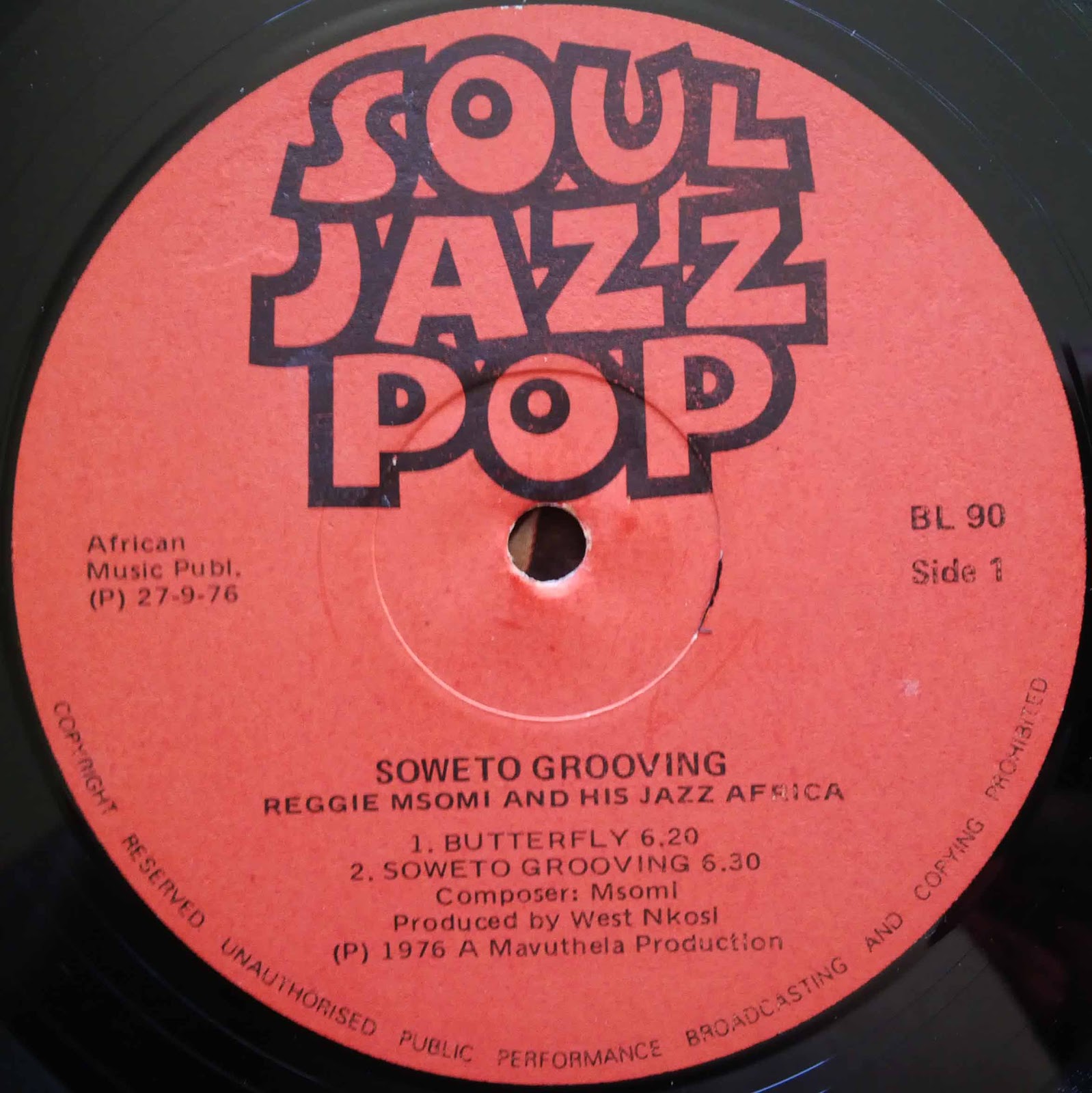
This soul compilation from the legendary Mavuthela stable lives in my top drawer of vinyls most often spun. Inspired by the September Jive energy, I found some time to digitize it.
West Nkosi and the flagship Soul Jazz Pop label were blessed with artistic riches, no filler here. A few of these tracks have already been featured in their original albums here on Electric Jive. If you have not yet heard these, here is your perfect sampler. If you have already, The Makhona Zonke Band's "Walk to Jo'urg" is new to EJ, while "The Webb" and "Somewhere There" featured on Matt's special post earlier this year.You may or may not have heard Jacob "Mpharanyana" Radebe's Oho Morena, but there are three other tracks featuring the Cannibals.
There are some new gems here too,new to Electric Jive anyway. The Mthunzini Girls are going to surprise you with some multi-vocal swinging soul. Ray Chikapa Phiri gives the Cannibals "Be A Man". Reggie Msomi's "Tsikiza" gives bump a whole dose of soul.
When Patience Africa has featured on this blog, it has been a popular post. The most popular post on Electric Jive, for example. Nick Lotay writes agreat essayfor a wonderful disco soul compilation. He says the following about Patience Africa:
"After a subdued musical start and then a long period of family life, Patience joined West Nkosi in around 1976 and spent some six or seven years under his production recording successful solo material, backed by West’s various soul teams including The U-Vees, The Shoe Laces and (most successfully) The Peddlars. She was awarded “Best Female Vocalist” numerous times by the SABC in its unnamed blacks-only version of the SARIE Awards. Though these ceremonies were more or less shambolic and by and large insulting to the musicians they were supposedly rewarding, Patience really was a top talent deserving – like all her contemporaries, no matter the style of music – of so much more."
Heads up to lovers of South African music –
first in Johannesburg, but also travelling to Cape Town and Durban. A visual
and aural feast of this country’s musical and artistic heritage – a buffet of movies,
exhibitions, and discussions.
September Jive is a tribute to the musical heritage of South Africa. A series of events
will
provide a platform to meet, discuss and engage around
the incredible diversity and history that makes South Africa such a rich musical country. September Jive comprises two exhibitions as well as panel discussions, screenings,
meetings and talks. It aims at promoting the South African musical heritage, from a
musicological, historical and visual perspective.
Exhibitions
SA musical
graphics - classics and collectables presents 150 of
the most interesting,
important and beautiful sleeve covers, with a special
focus on truly South African designs, which could have emanated only from
this country. The selection was made by a group consisting of collectors and designers (Siemon Allen,
Rob Allingham, Caroline Hillary, Molemo Moiloa).
My favourite
sounds - Music and media personalities speak out about their favourite
tracks and albums, consist of 50 photo portraits of music and media personalities
including Yvonne Chaka Chaka, Johnny Clegg, Brenda Sisane…
accompanied by short interviews about their favourite South African music and
explaining why they chose it. This exhibition is the work of photographer Kapula.
All events are free and open to anyone.
All the events are happening at the
Alliance Française of Johannesburg
17 Lower Park Drive, corner Kerry Road,
opposite Zoo Lake Parkview, Johannesburg
Thursday
01 September – opening of September Jive exhibitions
SA musical graphics - classics and
collectables
My favourite sounds - Music and media
personalities speak out about their favourite tracks and albums
Friday
02 September (18:30) – Film screening
Phuzekhemisi (Damon Heatlie): A biographical profile of this popular Zulu Maskanda artist who became the leading voice of protest for his beleaguered rural KZN community.
Wednesday
07 September (18:30) – lecture
Forbidden sounds, music and censorship in
the time of apartheid: This presentation explores the apartheid regime's popular music censorship practices, from the banning of 'undesirable' music from distribution (and sometimes possession) to keeping the airwaves clear of subversive messages.
(presented by Michael Drewett)
Friday
09 September (18:30) – Film screening
Amandla! A Revolution In Four-Part
Harmony (Lee Hirsh): "Amandla! A Revolution In Four-Part Harmony" is a soul-stirring documentary that uses exclusive interviews and rare, never-before-seen film footage to document the vital role that music played in the nearly half-century struggle against apartheid in South Africa.
Thursday
15 September (18:30) – panel discussion
Past to the present, old sounds to modern
ears: This panel discussion is about the re-issues market, from compilations to original albums. It focuses on 4 specialised labels, their successes and challenges in a time of sampling and DJs. Moderator: Richard Nwamba (SAFM), Panellists: Chris Albertyn, Rob Allingham, Alain Courbis, Benjy Moody.
Friday
16 September (18:30) – Film screening
Dilemma (Peter Maxwell) – excerpt ‘Dilemma’ was a full-length dramatization of a Nadine Gordimer story filmed in 1962. It contains this one memorable musical performance with (in order of appearance) Mackay Davashe, Pricilla Booi, Vinah Benele, Tandi Mpambane (Klaasen), Mabel Mafuya, Abigail
Kubeka, Blyth Mbitjana, Kippie Moeketsi and Wanda Makhubu
African Shakes (Basil Mailer): Filmed in 1965 and aimed at the ‘teenage’ audience, ‘Africa Shakes’ was a sometimes cringe-inducing attempt to replicate the Beatles ‘A Hard Day’s Night’ in a South African setting. However, with the benefit of fifty years’ hindsight, the film can now be savoured as a rare, pre-television era document of the local music scene, both white and African. Although ‘starring’ a second-rate British ‘beat band’, Bill Kimber & The Couriers, the film includes unique cameo appearances by Ben Nkosi, Reggie Msomi, Dana Valery, Lemmy Special Mabaso, Sharon Tandy, Abigail Kubeka (backed by Peter Mokonotela, Gideon Nxumalo, Chooks Tshukudu and Early Mabuza), Brian Poole & the Tremeloes (from the UK), Una Valli, Cy Sacks and George Hayden. Correction: Thanks to an email from Richard Laws we can correct this as follows: "We wrapped the film on my 18th birthday, May 15, 1964 (not, as is stated, in 1965), so to say that it was an attempt to somehow emulate "A Hard Days Night" would be incorrect. The two films were shot at approximately the same time. As the Couriers, we couldn't have seen The Beatles film until its release in London in July, 1964."
Thursday
22 September (18:30) – panel discussion
SA cult albums, divine sounds? This panel discussion addresses the notion of “cult” for a work of popular art. The 1968 song Yakhal' Inkomo by Winston "Mankunku" Ngozi is one of the best possible examples of a record achieving cult status. But what does it mean? And which social and political factors are at work to make such a work cult? Moderator: Brenda Sisane (Kaya fm) Panellists: Percy Mabandu, Lloyd Ross, other panellists to be confirmed.
Friday
23 September (18:30) – Film screening
Jiving And Dying - The Radio Rats Story
(Michael Cross): Twenty-five years in the making, this film introduces the music of Radio Rats and the words of Jonathan Handley in an attempt to afford them the place they deserve in the history of independent rock ’n’ roll in South Africa.
Wednesday
28 September (18:30) – lecture
A Brief History of the SA Musical Industry
(presented by Rob Allingham): This talk will cover a century of producing, marketing and distributing local music, from the early years to the greatest successes and to the downward trends of the present.
Friday
30 September (18:30) – Film screening
Future sounds of Mzansi (Nthato Mokgata
& Lebogang Rasethaba): Future Sounds of Mzansi is a documentary which aims to explore, express, and interrogate South Africa's cultural landscape, 20 years into its democracy... A chief vehicle of this exploration is electronic music, a staple of South African popular culture. The film explores the past, present and future of the scene and its multiple sub-genres, presented through the eyes of internationally acclaimed artist Spoek Mathambo.
September Jive is promoted by
Alliance Francais in partnership with SAMRO Foundation, Institu Francais,
Afrique du Sud.
A 1977 South African jazz recording involving
saxophonist Aubrey Simani. I am hoping that readers can help me with more
information – for example, who was “A. Nxumalo”? Sadly, this is one of those records in my collection
that does not possess the original cover. The cover picture displayed here was one of the 150 covers displayed at Alliance Francais' Vinyl September exhibition during 2016. The music more than makes up for an
absence of information though.
Aubrey Simani was not lightweight. At the
age of 22 he was playing alto saxophone to Mongezi Feza’s tenor as a member of Eric
Nomvete’s Big Five, at the 1962 Castle Jazz Festival where they performed the ground-breaking
“Pondo Blues”. Before that, Simani was a member of Tete Mbambisa’s “Four Yanks”, which also included Dudu
Pukwana.
Simani joined up with Johnny Mekoa in 1967
to form the Jazz Ministers. Switching to tenor sax in the 1970s he contributed
to a number of important recordings. In 1976, for example, his credits included
at least four full albums: Tete Mbambisa’s Big Sound, Dick Khoza’s Chapita, Reggie
Msomi’s “Soweto Grooving”, and then with the Jazz Ministers Live in Newport.
Track three (One for Erick) is most likely dedicated
to Eric Nomvete. Simani was killed by a car in Mdantsane on
11 August 2009.
This jukebox idea came from an idle daydream about how much space would be needed to store one of every record that was ever made and pressed in Johannesburg since 1932 when Eric Gallo established South Africa's first press.
South Africa's recorded music heritage is one such "jukebox" with too many lost, forgotten and out-of-print musical creations. An uncounted large number of recordings have been made to cater for diverse and eclectic musical, tribal and sub-cultural tastes. In the course of digging for records I have turned up some great music on 78rpms or 45rpms that I cannot find on albums. So, how then to present them on this blog?
The original records were bought by a sizable urban African populace and enjoyed at household parties, shebeens, fund-raising dances in halls. While I cannot find evidence of jukeboxes having played much part in this scene, the idea of a "jukebox selection" makes for a comfortably loose way of grouping some rare and out of print records together for a post on Electric Jive.
Imagine if you will, a massive jukebox filled with the most diverse representation of sounds that were recorded and sold in cities and towns across the country. Traditional tribal "trance" recordings made by visitors to the studios, gospel and religious choirs, mbaqanga, soul, jazz, disco, funk - it was all very much part of the possible "selection" from what was available.
Electric Jive Jukebox Number One is a selection of 60s mbaqanga with some swing and jive themed around a train-ride holiday-to-Durban. Some great female vocal jive, swing and mbaqanga for a sub-tropical Durban holiday feeling ... just like it has been this long-weekend. Enjoy
1. Isitimela Sase Tekwini - Trutone Dolls (78rpm Stokvel ST.019).
2. Kumnandi Ethekwini - Reggie Msomi's Love Birds (45rpm Gumba Gumba MGG698) (1977).
3. Gijima Mfana - Mthunzini Girls (78rpm Motella MO120).
4. Big Brain Jive No.2 - Transvaal Rocking Jazz Stars (78rpm Columbia YE6039).
5. Ndode Khohlanele - Thandi & Lo Six (78rpm Zonk TV.222 )
6. Lucky Star Twist No.2 - Golden City Sisters (78rpm Tempo KT.525)
7. Ngaliwe - Durban City Queens - (78rpm DRUM DR166)
8. Dudu - Thandi & Lo Six - (78rpm Zonk TV.222)
9. La Conga - West Nkosi (78rpm Gallo USA USA321)
10. Erautini - Shanty Town Trio with Thandi Mpambani (78rpm Colombia YE55)
11. Wongkhonzela - Durban City Queens (78rpm DRUM DR166)
12. Madison Square No.2 - Golden City Sisters (78rpm Tempo KT.525)
13. Union Express - Albert Ralumini (78rpm RCA Victor Top Beat RCA291)
14. Durban Road - Makhona Zonke Band
15. Iwisa Lakho - Johnson Mkhalali with the Mabone Boys (45rpm GoGo GGB612) (1977)
16. 1968 Special - Mr V. Mzwandile & His Accordeon (45rpm Up Mavuthela UPM812) (1973)
17. Mthathe Masaka - Boy Masaka (78rpm Columbia YE0658)
18. Ungalile - Joyce Mogatusi & Boy Masaka (78rpm His Master's Voice JP876).
These artists need no introduction—Spokes Mashiyane and Reggie Msomi can be found countless times here at Electric Jive. The New Sound album featured today brings together a wonderful selection of early sax jives probably first issued on 78 rpm around 1959 and 1960. This compilation (c1961) follows two hit volumes also issued by Gallo: New Sounds of Africa Vol.1 (NSL 1001) and Vol.2 (NSL 1002). While those earlier LPs focus primarily on Spokes Mashiyane, Miriam Makeba and the Skylarks, this record may be the first 33 rpm to foreground the talents of Gallo producer Reggie Msomi. Of course, this disc is marked as "New Sound Vol. 3" but it is hard to know if it follows that earlier series or whether NSL 1004 and 1005 are its precursors. It may be possible that Reggie can be found on those "missing" LPs. His 1961 classic Twisting with Reggie (NSL 1007) can be heard here at Electric Jive. For a partial discography of Gallo's New Sound label check out flatint.
Spokes Mashiyane and His Big Five
01) Nyakaza Stan
02) Chukuchuku
03) Lova
04) Bochabela
05) Phatha Phatha No. 2
06) Mojira Special
Merry Christmas and Happy New Year from Electric Jive!
We hope you’ve been enjoying the festive treats shared throughout December – and it is my pleasure to bring 2014 on EJ to a close with a smashing goody bag of 1960s and 1970s mbaqanga. Whether you’re ringing in the New Year with a celebratory party or doing something rather low key does not matter one iota – whatever your situation, our New Year Jive is the compilation that you NEED to be playing at full volume (and dancing along to) when the clock strikes twelve!
The girl group and groaner combination almost exclusively dominated the black pop music scene of 1960s and 1970s South Africa. The origins of the trend go back to the late 1950s with the birth of a girl group factory-line, the slow development of jive and the ultimate decline of intricate African jazz. Electric instrumentation arrived at the right time and the foundations of mbaqanga were laid. The tame early electric jive soon advanced into the now familiar rock-solid elastic mbaqanga, personified by fierceness, energy and thunder. Ensembles like the Sweet Sixteens and the Dark City Sisters successfully paved the way for the Mahotella Queens, who in turn influenced the formation of Izintombi Zesi Manje Manje, and on and on the story goes. Key to the success of the new mbaqanga girl groups were the strong-willed and determined studio producers (or ‘talent scouts’) who ran tight ships, encouraged a factory-line approach to music making and held close relationships with people in the right places – which ensured mbaqanga music was almost vehemently propagated across the state broadcaster’s Radio Bantu service. Although this chagrined the African elite, mbaqanga was already becoming a national craze and the black public firmly embraced the music in very much the same way their counterparts in the United States embraced the Motown sound.
“Utshodo Lumantwengu” is a fantastic example of mid-1960s girl group mbaqanga. This tune, telling the story of a girl fighting off the advances of a romeo hobo, was recorded in 1966 by Nobesuthu and Gcaba Twins. This shortlived trio produced a number of up-tempo vocal jives during 1965 and 1966 before the main singer – Nobesuthu Shawe – joined the rival Izintombi Zesi Manje Manje in 1967. One of Izintombi’s first big hits was “Pendula Magwala”, a fast-paced number with thrilling drum patterns and tightly layered vocal harmonies. Izintombi’s lead singer was Sannah Mnguni – who by 1972 had built up enough recognition and popularity to feel able to quit the group and form a brand-new ensemble named Amagugu. Sannah’s notoriety is celebrated in a collaboration with Zulu-traditional guitarist Frans Msomi and violinist Ncane Ndlovu, the appropriately-titled “Sannah”.
Although Izintombi tried and sometimes even overtook them in the popularity stakes, the Mahotella Queens were South Africa’s most popular girl group of the mid-to-late 1960s and early 1970s, releasing a string of hugely successful singles (on both 78 and 45rpm) and performing in venues ranging from wedding parties to huge soccer stadiums. “Jive Jibav No. 7” tells every boy and girl in the country to take part in the latest dance craze, while “Isigubhu Sabalozi No. 2” – the 1972 follow-up to a huge 1970 hit of the same name – emphatically states that the tough Mavuthela mgqashiyo beat shall never die. By the mid-1970s, the Queens’ tour schedule was so hectic that a number of other vocalists kept their name going on record. A multi-tracked Irene Mawela performs “Uthando Luyisilima” alongside Potatoes Zuma, aka Indoda Mbhodlomane, a wonderful bass vocalist but someone whose stage name rides the waves of that true king of the groaners, Indoda Mahlathini.
Two other groaners following in Mahlathini’s footsteps were Umfana Wembazo – real name Robert Mkhize – and Boy Nze – otherwise known as Lazarus Magatole. Mbazo’s vocals can be heard punctuating the chorus in Dulcie Luthuli Nabalilizeli’s “Ntomb’uthini” and in his own splendid solo effort, “Maye Mina”. Boy Nze’s “Uzobuya” isn’t one to miss either – it’s perhaps one of the finest solo records from a male vocalist that I’ve ever heard.
Alongside the Queens at Mavuthela were junior bands, some of whom over the years included the Mthunzini Girls, Izintombi Zomoya, Umgungundlovu Dolls, Love Birds and many others. The Mthunzini Girls borrow from the US and inject soul into the mbaqanga brew – Paulina Zulu is the lead singer on (and songwriter of) “Tsohang” and “Ikele Ngoaneso”, two downright funky Sotho tunes that should at least make your foot tap. Izintombi Zomoya’s “Isilomo” – a fantastically rapid tune with animated vocals and excellent lively instrumentation – should also stir your soul.
A few more notable highlights for me - "Orlando", featuring the perennial vocal sound of the Dark City Sisters in all their mid-1960s glory, with Esther Khoza shouting words of praise for the Orlando Pirates; the group's 1976 Sotho ode "Dikgarebe" with Grace Msika's mid-song chant and Joyce Mogatusi's inimitable alto; "Daly", from the somewhat unknown Lesotho Sisters, just for the delightfully swish three-part harmonies; "Sophie" by Izingane Zomgqashiyo and its sweet lead guitar patterns; the strength of vocal passion in the Umgungundlovu Dolls' "Vuka Uvale"; the archetypal electric elasticity in all its glory in Reggie Msomi's Love Birds' "Uzwakanjani"; and the effective simplicity of the all-too-short "Umhlaba Awunoni" from Izintombi Zesi Manje Manje under another name.
So that’s all from Electric Jive for the moment. Whatever the New Year brings, you can rest assured we'll still be doing our utmost best to bring the sounds of yesteryear back to the forefront where they belongs. We're very grateful for all the support and appreciation you send our way - we just do it for the music and the people who created it all. So... download the following mix of mbaqanga heaven and clear the floor, ready to jive until you drop.
See you in 2015!
Enjoy!
NEW YEAR JIVE!
COMPILED BY NICK LOTAY
01) NOBESUTHU AND GCABA TWINS – UTSHODO LUMANTWENGU (1966)
02) DARK CITY SISTERS – ORLANDO (c1965)
03) S’MODERN QUEENS – PENDULA MAGWALA (1967)
04) MARULA BOOM STARS – JIVE JIBAV NO. 7 (1965)
05) LESOTHO SISTERS – DALY (c1966)
06) IZINGANE ZOMGQASHIYO – SOPHIE (1968)
07) IZINTOMBI ZOMOYA – ISILOMO (1972)
08) BOY NZE – UZOBUYA (1971)
09) DULCIE LUTHULI NABALILIZELI – NTOMB’UTHINI (1971)
10) MSOMI AND AMAGUGU – SANNAH (1977)
11) UMGUNGUNDLOVU DOLLS – VUKA UVALE (1970)
12) MTHUNZINI GIRLS – TSOHANG (1972)
13) IZINTOMBI ZESI MANJE MANJE – SHE KEEPS ON KNOCKING (1974)
14) MTHUNZINI GIRLS – IKELE NGOANESO (1972)
15) AMAQHAWE – UMHLABA AWUNONI (1974)
16) DARK CITY SISTERS – DIKGAREBE (1976)
17) MAHOTELLA QUEENS – ISIGUBHU SABALOZI NO. 2 (1972)
18) INDODA MBHODLOMANE & MAHOTELLA QUEENS - UTHANDO LUYISILIMA(1974)
19) UMFANA WEMBAZO – MAYE MINA (1974)
20) REGGIE MSOMI’S LOVE BIRDS – UZWAKANJANI (1977)
We're keeping this instrumental theme going for just a little bit longer here on Electric Jive. Why? Well, why not?! Sax jive happens to be one of the most peppy and sweet styles of instrumental dance music that has ever existed - and what better way of celebrating the genre than sharing with our readers another bumper collection of the very best sax jives? Following on from our last delve into the archives, we present to you Sax Jive Special - Vol. 2.
The Makgona Tsohle Band were the first guys on the scene in the 1960s to take the swing-style instrumental jive and reshape it into the more danceable, more electric and elastic mbaqanga beat which soared to amazing heights. If just one listen to real gems like "Umzinto", "Cowboy" or "Sithunyiwe Thokozile" doesn't at the very least get your foot tapping, then there's something truly wrong with your musical tastes. Under various recording pseudonyms, the men behind the Makgona Tsohle Band created the biggest instrumental hits of the day. That team - Marks Mankwane on lead guitar, Vivian Ngubane on rhythm guitar, Joseph Makwela on bass, Lucky Monama on drums and West Nkosi leading on alto saxophone - was the gold standard, the benchmark against which all other mbaqanga bands were measured.
The Makgona Tsohle Band didn't just back West - they were the Mavuthela house band who generally backed every one of the stable's saxophone players and vocal jive groups. Lemmy 'Special' Mabaso shot to fame as the child pennywhistler of the late 1950s - but by the 1960s, with kwela out and mbaqanga in, he turned to the alto sax and joined forces with Makgona Tsohle for a series of recordings that included "Sipho Special". You can clearly hear everyone in the studio feeding off each other's high spirits on this bouncy number.
Spokes Mashiyane, the man who brought sax jive to prominence, also joined forces with Mavuthela during the 1960s. It might be true to say that the great Mashiyane became sidelined and unappreciated as the style developed further and further into the more hard and bouncy mbaqanga, with the spotlight focusing instead on fresh young talent like West Nkosi, David Thekwane, Reggie Msomi, Boy Masaka and others. Mashiyane did continue to record sporadically though and did create some great sax jives with the Makgona Tsohle Band, such as "Kgwale". "Sediba" is also an enjoyable tune featuring Mashiyane on top form. The real star here though is Vivian Ngubane who bends the melody fantastically with his rhythm guitar. Ngubane, for some rather puzzling reason, seems to be generally forgotten compared to those he worked with such as Marks Mankwane and Joseph Makwela. This is all the more strange because Ngubane was nothing less than a trendsetter. His rhythm guitar, sandwiched between Mankwane's lead guitar and Makwela's bass, became the signature elastic bedrock of the music. Until Ngubane joined the Makgona Tsohle Band late in 1964, the rhythm guitar line was still being filled by an acoustic guitar player who strummed nothing more than simple chords. Ngubane's trademark sound opens "Umzinto", a good example of the staple instrumental mbaqanga that Makgona Tsohle pumped out of the Gallo studio every week.
Sipho Bhengu, before joining the famous Mango Groove and lending them his wonderful talents, was a supreme sax jive star of the 1970s. His "Welani Imifula" opens with a boisterous spoken word from Mavuthela's boss Rupert Bopape and then gives way to the musical backing of the Jets and Sipho's great sax rhythms. Another sax jive star was Selby Mmutung - better known to you and me as Bra Sello. Sello made his name playing with Abafana Bentuthuko and later joined Mavuthela, working with the late genius Mzwandile David to produce sax-accordion jives under the name Mathwalimbuzi. "Umsuzo" rather bizarrely refers to someone breaking wind and Sello certainly creates the right impression during the opening of the tune. Reggie Msomi was also a talented somebody. During the 1960s, Msomi and his Hollywood Jazz Band (usually comprising Reggie on sax backed by the talented Makgona Tsohle Band!) produced some rather adventurous instrumental hits - taking sax jive and mixing it with various other styles such as soul, ska or reggae. "Chumba" is a great tune with some hints of Congo rumba. Aaron Jack Lerole also turned and twisted sax jive and took it to newer heights. "Space Age" is simply amazing - just listen and hear for yourself.
The marvellous Zwino Zwino Boys, led by bass guitarist James Mukwevho, bring our compilation to a fitting close with the excellent "Thala Thala". This has to be one of my favourite sax jives of all time. Sam Jagome effortlessly kicks everything off with a few calm strums of his electric lead guitar. The rest of the band joins in and this combined force works up some truly magical rhythms. The late Sam has to be one of the forgotten geniuses of mbaqanga music. He followed Marks Mankwane's unique innovations and ended up creating a signature style all of his own. Sam's beautiful lead guitar strains could be heard not only in the Zwino Zwino Boys but also behind the spirited vocals of Izintombi Zomoya.
Our thanks to Laurent Dalmasso for contributing two wonderful tracks to this compilation from the original 78 rpm discs - "Sediba" and "Sipho Special". All you need to do now is download this mix and get yourself ready for some serious jiving until you drop.
ENJOY!
SAX JIVE SPECIAL - VOL. 2
01) PAKU PAKU - MAKHOLOKHOLO (1965)
02) SEDIBA - SPOKES AND HIS GOLDEN SAX (1966)
03) UMZINTO - LUCKY MONAMA AND HIS PARTNERS (1968)
04) CHUMBA - REGGIE MSOMI AND HIS HOLLYWOOD JAZZ BAND (1969)
05) SIPHO SPECIAL - LEMMY MABASO AND HIS SAX (1965)
06) JIVE SMODERN JIVE - MAKHOLOKHOLO (1965)
07) COWBOY - WEST NKOSI AND HIS SAX (1967)
08) TADIMA TADIMA - ZWINO ZWINO BOYS (1971)
09) WELANI IMIFULA - SIPHO BHENGU AND HIS JETS (1973)
10) MANYANE JIVE PART TWO - POPS AND SONS (1976)
11) PULL MAN NO. 2 - MARKS AND THE SHALUZA BOYS (1976)
12) UMSUZO - MATHWALIMBUZI (1976)
13) BATHATHE GEORGE - ABAKHWENYANA (1973)
14) KIT BAG - MAMBAZA NABAFANA BOMSHOSHOLOZO (1971)
15) FOUR MABONE - WEST NKOSI NABASHOKOBEZI (1973)
16) AMANZI AMANCANE NO. 5 - LUCKY MONAMA AND HIS PARTNERS (1971)
Reggie Msomi, the legendary composer, arranger, producer, guitarist, saxophonist and more, was, in my opinion, one among a handful of South Africans who have contributed in such a high quality, prolific, diverse and boundary-stretching manner to this country's musics over a sustained period of time.
Just browse through Electric Jive's archives (use the search bar on the right-hand column) and you will find his contributions stretching over twenty years: as composer and band-member of the Tophitters in a 1957 kwela-jive, then as a key member of the ND Hotshots in 1960 on the wave of inventing mbaqanga along with a big-band swing infusion - all the way via twist, ska, and mbaqanga through to his 1976 hit albums "Soweto Grooving" and "Swing Africa." If you have not heard these, do yourself a favour and search 'Reggie Msomi' in the side-bar - the links are still live.
Reggie Msomi (1962)
From an album featured on
Flatinternational here
As Siemon Allen describes in an earlier posting on this blog: "In 1962 he formed the Hollywood Jazz Band and also became a producer/talent scout for Gallo. Alas, in 1964 he was replaced by Rupert Bopape in an unfortunate turn of events recounted in Nick Lotay’s classic post Jive Motella! on the history of Mavuthela at Matsuli." While Msomi was touring with the Hollywood Jazzband north of the border in Southern Rhodesia there was a palace coup of sorts.
Today's rarity is an SABC transcription of "Reggie Msomi and His Hollywood Band", we believe to be from 1963. By this time Reggie Msomi had recruited Joseph Makwela (bass) and West Nkosi (saxophone) to the Hollywood Band - after he heard them repeatedly busking outside the doors of Gallo. Lucky Monama (rhythm guitar) was already at Gallo and part of the Hollywood Band. Makwela, Monama and Nkosi would go on to later form the core of the Makona Tsohle Band.
This transcription features six great Msomi tunes from by a very polished band. I tried all I could to remove the slight interference that accompanies the beginning of most of these tracks. They are brief - the music endures.
This isn't a groundbreaking album. But there is something quite attractive and endearing about it, from the striking cover art to the tasty, bouncy sounds gracing the grooves of this record. Like hundreds and hundreds of LPs released in South Africa during this particular era, Game 1 - Game 2 is a compilation of 12 songs from previously-released singles, comprising some of the best sax jive material of the last year. In other words - this is instrumental mbaqanga heaven.
The tunes on Game 1 - Game 2 are short, sweet and peppy - and why would one want anything more than that...? Alto saxophonist Sipho Bhengu launches the album on a bright and happy note, and he is joined immediately by the rest of the members of the Mavuthela studio band Abafana Bezimpalampala. "Inselelo" is a simple tune but, like every other song on the LP, very infectious. Bhengu, who recorded under such memorable pseudonyms as "Sammy Boy and His Sax", "Sipho and His Jets" and "Sammy Boy Nezimpisi", features in three other songs, including "Black Stick Soul", a lovely soul-type number with florid late-60s organ.
There's another soul-influenced tune on the LP, "Jungle Soul" (one of my personal favourites), as recorded by Joseph Makwela and His Comrades - yet another 'black music'-era smokescreen for the musicians of the Makgona Tsohle Band. For those wanting the sound of the original sax jive formula though, not to worry - there's plenty of that on Game 1 - Game 2, and it's seriously good stuff. Makwela and his Makgona Tsohle bandmates turn up again for "Umgqizibo", another 'little but big' tune. Marks Mankwane's hugely popular "Marks Special" series of songs isn't forgotten either, with No. 3 represented on this LP, featuring the sound of his legendary lead guitar alongside the groundbreaking Makwela on bass, the excellent (and often forgotten) Vivian Ngubane on rhythm guitar, and the rhythmic brilliance of Lucky Monama on drums.
...and speaking of Monama, let us not forget about the back-and-forth amazingness of "Phakama Masuku", a great number recorded by Lucky Monama and His Partners (yes, the Makgona Tsohle Band under yet another different name!)
There is one other tune, "Chumba", recorded by Reggie Msomi and His Hollywood Jazz Band - a fabulous number that shouldn't be missed.
Game 1 - Game 2 - a veritable melting pot of staple sax jives. Enjoy!
When I have the good fortune of meeting up with old friends who live far away from my home I often cannot help myself in putting together a mix-tape of musical delights to mark the occasion. More so if this friend of thirty years shares a blog with you and is visiting the motherland on a kind of musical working holiday which includes launching the re-issue of "African Songbird" in Cape Town this coming weekend.
For those of you who cannot make it to Cape Town there is a good possibility that the performance will be streamed live from Tagore's Jazz Bar - do stop by the Pan African Space Station (PASS) website and check for updates HERE. So, in addition to encouraging Cape Town residents to join us in celebrating Sathima Bea Benjamin this weekend, the purpose of this post is to celebrate my long-weekend 'holiday' excitement with a preview selection of tracks from albums that I plan to share on electric jive in future. ( I have been working hard on digitizing as I have a very unfortunate work travel schedule over the next six months). Also, it always gives me pleasure to give Matt Temple a mix-tape CD with one or two tracks he probably has not heard before, to slot into the car-player as we embark on our adventures around Cape Town.
I feel very privileged to be going to meet and listen to Sathima performing with Hilton Schilder and his band in an intimate setting. I have already packed a number of Ian Huntley's photographs to ask Sathima, her sister Joan (Flower of Cape Town), and anyone else who can help in identifying a number of musicians. The book layout and printing deadline looms and the more detail we can insert in the captions, the better.
Turning to the screening of Dan Yon's documentary on Sathima this Sunday, I look forward to learning more about her remarkable life and art. Having read Patti Smith's account of life in New York's Chelsea Hotel, I am curious to hear of Sathima's experience of this extraordinary establishment and its residents. Preview of Sathima's Windsong.
Then there is Future Nostalgia on Tuesday evening at the Mahogany Room, with Matt spinning an all-vinyl set.
So, without further ado, herewith a sampler of tracks selected from amongst various albums I plan to share on electric jive in the future. While some of the tracks are covers, they are all performed by South African artists. The download is in mix-tape format - the separated tracks and full albums will become available in due course. Enjoy!!
1. Reggie Msomi - No Pay No Play (SABC Transcription ~1965)
2. Tony Bird - Song of the Long Grass (Tony Bird - 1976)
3. Jenny Cantan - Sunday, Monday, Tuesday, Wednesday (Radio Bantu Hits 1972)
4. Wanda Arletti - Love Power (Love Power - 1969)
5. Teaspoon Ndelu and His "T" Boys - Ukhezo Oluncane (Manyeledi, Mayeledi - 1972)
6. Malopoets - Sound of the People (Fire - 1982)
7. John Moriri and the Manzini Girls - Wenzani Lomfani (Isikhova - 1976)
8. Willie & Paul - Umalokozana (Umakoti ka Themba - 1982)
9. The Sounds - Thiba Kamoo - (Super Soul - 1974)
10. Faro - Vai La Casa (Muporofita - 1990)
11. Inyanga - Ingwe (Inside the Night - 1982)
12. The Sounds - Bushy Mayanka (Super Soul - 1974)
13. Julius Mdaka and the Manyunyu Sisters - Mipoyiyekile (Xiphayu Xamhunhu -1985)
14. Abafana Bamogoduka - Amachachacha (Manyeledi, Mayeledi - 1972)
This post will be my last for a while at Electric Jive. I am taking some time to concentrate on a number of other creative projects. I want to thank the team here at EJ for inviting me two-and-half years ago to be a part of this amazing resource. Much of South African music history remains undocumented and significant information is rapidly fading away. Electric Jive continues to provide a critical window onto that history and I am honored to have played a small part in this valuable archiving project. Chris, Matt, Nick and Francis thank you so much!
For this final post I though it might be appropriate to feature two LPs from Gallo’s New Sound label: Lemmy Hit Parade No. 1 (NSL 1008) and Top Hits of the Big Three (NSL 1006). Both are exceptionally hard to find and seldom, if ever, come up on the various auction sites.
Gallo introduced the New Sound label in 1958 as a marketing strategy to brand their more popular jive and kwela releases. It set those recordings apart from their own more “traditional” ones and became a visually catchy product that could rival the competition. The familiar vermillion and yellow label was a bright, modern shift away from the more conventional black, gold and silver label designs of the preceding decades. (For more on the New Sound label check out my provisional discography at flatint.)
The label showcased some of Gallo’s most popular jive and kwela artists of the late 1950s and early 1960s including Lemmy 'Special' Mabaso, Spokes Mashiyane, Miriam Makeba and the Skylarks, Reggie Msomi to name but a few. Significantly this label was introduced just as Gallo was signing Mashiyane away from Trutone and it also arrived as the popularity of kwela was peaking internationally. The timing in my opinion cannot be coincidental.
The label, like the music, was bright and easily identifiable. Early issues carried the name Gallotone in a modern san-serif font (the previous logos were all in cursive) but this too was dropped in favor of the clean simplicity of just “New Sound” next to the Gallo rooster logo.
At first the design was used only on 78 rpms, which at that time were chiefly marketed to black consumers. In 1959, some discs were issued as 45 rpms, and in 1960 the company began a series of LPs and EPs featuring some of their best artists. It is likely that these formats were to be marketed to white consumers. New Sounds of Africa, Vol. 1 and Vol. 2 were the first two LPs issued and included primarily tracks by Spokes Mashiyane but also significant hits by Miriam Makeba and the Skylarks. Coincidentally these came out just as Makeba was becoming popular in the United States — she had left South Africa in August of 1959.
The label continued with a string of LP releases featuring Mashiyane, Mabaso and Msomi and then in 1962 issued the classic live recording of the 1962 Cold Castle National Jazz Festival. Generally Gallo issued jazz recordings on their Continental label, but this LP marked an important departure. This was soon followed by an even more significant classic in Jazz - The African Sound featuring Chris McGregor’s Castle Lager Big Band - one of the most collectable South African records.
New Sound maintained issues until around 1965 when it was replaced by Mavuthela's iconic Motella label under the stewardship of Rupert Bopape. Introduced in 1964 soon after Bopape joined Gallo, Motella became home to the leading South African musical styles of the late 1960s. Mavuthela followed up with other new labels including Gumba Gumba, CTC Star, Smanje Manje and so on.
The two LPs featured today both include tracks by Lemmy 'Special' Mabaso who, in the late fifties along with Spokes Mashiyane, was South Africa’s biggest kwela star. As with all New Sound issues till this point both LPs are compilations of recordings previously issue on 78 rpm.
Mabaso was born in Alexandra Township in 1946 and along with his brothers Jerry and Meshack and three friends formed the Alexandra Junior Bright Boys, a four penny-whistle group accompanied by string-bass and guitar. They would busk the streets of Johannesburg for tips before making their first recordings probably around 1956 or 1957. Mabaso must have been ten or eleven at the time. (Huskisson)
The Alexandra Junior Bright Boys with Mabaso became some of the first black artists in South Africa to be featured on a long playing vinyl record in the 1958 compilation Something New in Africa(GALP 1015) and then again that year on the 10” LP Lemmy Special (GLP 119), both on the Gallotone label. By this point Mabaso must have been twelve.
Lemmy Special, as he is known on many of the recordings, became an overnight sensation and soon found himself performing in some of the biggest stage shows of the day, including African Jazz (1957) and both local and international stage productions of King Kong. After the decline in popularity of kwela he shifted to saxophone in 1963 and joined Reggie Msomi’s Hollywood Jazz Band before forming his own group, the Down-Beats. (Huskisson)
Mabaso continued recording for Gallo well into the 1970s and can be heard playing saxophone on many albums, including Ntemi Piliso’s classic 1975 sessions with the Members. Do yourself a favor and search for Lemmy here at Electric Jive to see the many other LPs he is featured on.
See you later!
Lemmy Hit Parade No. 1
Lemmy Special
New Sound
NSL 1008
(1962)
Top Hits of the Big Three
Spokes Mashiyane, Lemmy Mabaso, Reggie Msomi
New Sound
NSL 1006
(1961)
Soweto has long been a vibrant attraction for fortune
seekers from all over South Africa and further afield. Reggie Msomi and His
Jazz Africa attest to a pleasing accommodation of multiple roots, most probably
originally forged in the pulsating Pelican Night Club.
Soweto somehow always seems to effortlessly fuse the old and
the new, the young and the old. Leaders such as Msomi and Lemmy Mabaso had been
producing great music since the late 1950s, while other names appearing on this
album were yet to become famous – for example guitarist and singer Ray Chikapa
Phiri went on to form “Stimela”. “On first alto sax Lemmy Special Mabaso from Diepkloof
Johannesburg; on tenor sax Aubrey Simani from Meadowlands Johannesburg; on
baritone sax Freeman Lombatha from East London, Eastern Cape; on tenor and
guitar Reggie Msomi from Port Shepstone, Natal; on lead guitar Chikapa Phiri
from Nelspruit, Eastern Transvaal; on bass guitar Richard Shongwe from Nelspruit;
on drums Isaac Mtshali also from Nelspruit.” (from the sleeve notes).
If you have not heard the other great Reggie Msomi offerings
on Electric Jive, do yourself a favour and use the ”SEARCH” function on the
right hand column of this blog:
Recorded at the EMI
Studios in Johannesburg on 27th September 1976.
Recording Engineer;
Glen Pearce Produced by West
Nkosi Soul Jazz Pop BL90
Some seriously funky and soulful dance-floor filler noticeably South African music
lurks under the very competent disco veneer of this album.This band is certainly up there with anything
Reggie Msomi and Almon Memela were able to produce at the time. In addition to a strong seven-piece outfit featuring Lemmy ‘Special’
Mabaso on alto sax and Joe Zikhali (Chapita) on lead guitar, Zane Cronje takes credit for
the string arrangements. I cannot find further reference to alto sax player Boikie Piliso, and do not know if he was related to the famous Ntemi and Shadrack Piliso brothers.
When Cambridge Matiwane started his illustrious music career
I am certain he could not have foreseen producing a 1977 disco date, heavy
breathing included.
Joe Zikhali wrote “Sweetie”, the most
‘disco’ of the tracks, replete with the rhythmic moans and grunts that seemed
popular to this genre at the time. From there it is three tracks of upbeat
funky guitar and horns, with occasional strings holding onto that disco
dance-floor and mirror-ball feel.
The two tracks on side two are penned by keyboard player Dimpy Tshabalala, who in 1987 went on to join the reformed Elite Swingsters. “Moshate” features an eleven-minute fusion, funk and disco
workout. “Lazy Bones” is my personal favourite, looping, loping and driving. Enjoy!
If there are enough 70s disco lovers still lurking 'out there', let me know and I will make the effort to dig out some more South African disco from that era.
I promised after my first post of less common material by Miriam Makeba — Tracks Less Travelled — that I would follow up with more, equally rare, sounds by the singer on 78 rpm. Today, fifteen months later, we feature that second compilation. The tracks here all come from the period before Makeba left South Africa in August 1959 and in many ways trace the growth of her early career — first as an individual (after many recordings with the Manhattan Brothers) and then with the all-female, close-harmony groups: the Sunbeams and the Skylarks. To my knowledge, none of the material below (save for one track) has been reissued in any subsequent format. Most of this material has not been heard in almost 55 years.
Makeba was an icon and pioneer of what has come to be called "world music" long before the term even crossed the marketing desks of record companies. While I loathe the term, I wonder if it in fact accurately and appropriately describes an artist like Makeba who did not restrict herself to one culture but drew material from many languages and styles worldwide: Xhosa, Zulu, Swazi, English, French, Hebrew, Spanish, Portuguese, Guinean and so on. She truly was a "world singer".
On the other hand, the cynical side of me also recognises that those languages just happen to correspond with the particular places where her records were pressed and sold. So I have often wondered if her eclectic approach was not just an artistic choice, but also the result of pressure from international record companies to increase global sales.
I compiled the collection below in chronological order based on the matrix numbers of each recording and the results not only trace the evolution but also paint a portrait of an artist (and indeed a culture) open to a broad range of stylistic influences — even before her departure from South Africa. Calypso, gospel, close-harmony American popular music of the 1940s and 50s, but most significantly American jazz; all combined with local traditions to establish an eclectic palette.
The source of the calypso is not hard to pin point. Makeba's first two tracks in this style (recorded in 1957) are cover versions from Harry Belafonte's classic and influential album Calypso from 1956 (the first album to sell over one million copies). A fortuitous sampling — two years later it would be Belafonte himself launching Makeba's global career.
While there are few “hits” in the material below, there are still some significant gems and certainly the whole compilation, to me, has a really pleasant structure that would satisfy any mood, particularly at this time of year. The final few tracks with their significant gospel leanings seem most appropriate to the season. For the more popular material by Makeba from this period I would highly recommend the two CDs compiled by Rob Allingham and Albert Ralulimi: Miriam Makeba and the Skylarks (1956-1959) Vol.1 (CDGSP 3130) and Vol. 2 (CDGSP 3131). (Be sure to get the 2008 reissues each boasting five additional tracks and superior sound quality.)
Makeba with the Manhattan Brothers, c1953
Makeba began her career singing with her second nephew, Zweli Kunene, and his group the Cuban Brothers possibly as early as 1952. It was with the Cubans that Makeba made her first recordings, at that time, for EMI. In her book My Story Makeba maintains that it was while the Cubans were performing at the Donaldson Centre in Orlando East that she was spotted by Nathan Mdledle, lead vocalist of the Manhattan Brothers — South Africa's most popular vocal group at that time. Joe Mogotsi's account of the meeting (in his biography Matindane edited by Lars Rasmussen) is slightly different. He claims that Makeba approached Mdledle at the Donaldson Centre and only after a second interaction, did they come see her sing and then asked her to audition. Whichever the fact, in 1953, at the age of 21, Makeba joined Nathan Mdledle, Joe Mogotsi, Ronnie Majola and Rufus Khoza — the Manhattan Brothers — as their single female singer replacing Emily Kwenane, who was looking to pursue a solo career. Mdledle opted for her English given name as a stage name rather than Zenzi Makeba "as it sounded better" and Miriam Makeba became a star. (Makeba)
Mackay Davashe's Laku Tshon iLanga was her first big hit with the Manhattans but not her first recording. (That may have been Baby Ntsoare.) Gallo had sent the recording to a number of companies overseas and subsequently requested that the group re-record the song in English for an international market. With the help of American composer, Tom Glazer, Lovely Lies was the result pressed on the London label. Though Makeba was not a fan of the new lyrics — she felt that much of the core social drama of the original had been removed. Nevertheless, the song became their first big international hit and also the first South African song to enter the Billboard Top 100 in the United States, reaching position 45 in March of 1956. (Allingham) Because the composing process was generally quite fluid, Magotsi claimed that the Manhattans had an arrangement to share any composing fees with all involved regardless of who got the final credit. Davashe honored this arrangement for the original release but then conveniently failed to do the same for the English version. (Rasmussen) The credits in the latter went to: Davashe / Glazer.
Makeba talking about Lovely Lies in her first book also incorrectly stated that the recording was unusual as blacks were forbidden from singing in English. But according to Rob Allingham, this was not true the Manhattan Brothers had recorded a number of tracks in English in the 1940s and perhaps the lack of support for music in English by blacks may have been attributed to commercial concerns. Makeba's hits with the Manhattans include Baby Ntsoare, Laku Tshon 'iLanga, Tula Ndivile, Ntyilo Ntyilo, amongst others. All can be heard on the CD: The Very Best of the Manhattan Brothers (CDZAC 77) compiled by Rob Allingham.
Sometime in 1954, Makeba left the Manhattans to join Alf Herbert's touring show African Jazz and Variety featuring Dorothy Masuka, Dolly Rathebe and Lionel Pillay amongst others (Rasmussen has the date as 1954, Makeba has it as 1956) and then was again reunited with the Manhattans on Ian Bernhardt's variety show Township Jazz in 1955. She also recorded tracks under her own name for Gallotone in that same year.
The Skylarks: Mummy Girl Nketle, Mary Rabotapi, Makeba, Abigail Kubeka, 1956 from My Story
Early in 1956 Sam Alcock at Gallo encouraged Makeba to form an all female vocal group to compete with similar acts at Troubadour and Trutone. She with her half-sister Mizpah and Johanna Radebe recorded two tracks as the Sunbeams on GRC's Tropik label. (Makeba) The record sold well and the group was brought back into the studio but this time as the Skylarks on Gallo's Gallotone label. The women continued to record under both names for both labels. (GRC was an affiliate of Gallo's hence the common matrix numbers.) For the second session Mizpah was replaced by Mary Rabotapi who was fourteen at the time. The trio then expanded to four with the recruitment of Mummy Girl Nketle. Helen van Rensburg succeeded Johanna Radebe and in late 1957 Van Rensburg was subsequently replaced by Abigail Kubeka who was 16 at the time. As Allingham reveals in the liner notes to the Skylarks CD, the frequent changes to the group were all Makeba's doing. As Mary Rabotapi recalls; "She was the boss. [She] held the recording contract and she was the eldest [...]. Miriam wants hard workers, if you are slow on your feet, she'll take somebody else..." (Allingham)
The group was now set for many of the classic recordings of the late 1950s. On occasion a fifth female voice in Nomonde Sihawu would join the quartet with Sam Ngakane on bass. The Skylarks were prolific and in three years became South Africa's most popular vocal group recording over a hundred tracks and rivaling any of Gallo's other major acts. (Allingham)
Mogosti and Makeba rehearsing for King Kong, c1958. Source Ian Berry, Drum in Mona Glasser
Between 1957 and 1958 planning and rehearsals began on what would become the biggest hit of 1959, South Africa's first all-black African jazz opera: King Kong. The show was produced and directed by Leon Gluckman with music written by Todd Matshikza and included some of the key artists and musicians of the day. Makeba played the lead female role as Joyce, the girlfriend of the legendary and tragic boxer Ezekiel Dlamini, who was played by Nathan Mdledle. Other members of both the Manhattans Brothers and the Skylarks including Joe Mogotsi and Abigail Kubeka were also featured in the cast. The show opened to racially mixed audiences at the Wits Great Hall in February 1959 and then toured the country with much success for the next six months.
Meanwhile, Lionel Rogosin, a young American filmmaker had spotted Makeba performing in African Jazz and Variety in 1958 and recruited her to sing in his clandestine film about township life in South Africa: Come Back Africa (named for the ANC's freedom call Mayibuye iAfrica). The film was accepted into the 1959 Venice Film Festival and Rogosin invited Makeba to join him at the premier in Venice. Makeba applied for a passport to travel abroad and after many months of waiting and what she later described as a harassing interview she received one and subsequently left South Africa in August 1959. The film won the critic's award at Venice. (Makeba)
A few days prior to her departure, on August 12, Makeba joined the Skylarks in a scheduled studio session at Gallo and recorded four tunes. Two days later they returned and recorded ten more — her final session in South Africa. The very last song, aptly titled Miriam's Goodbye to Africa, was only released after she had already left, but became one of the Skylarks most successful tracks. (Allingham)
Just as Makeba had left South Africa after the success of King Kong, so to did the Manhattan Brothers go into exile after the UK production in 1961. In Joe Mogotsi's biography, he recalls some hard times during that period and reflects with some bitterness on how in 1964 their London manager had tried to make contact with Belafonte and Makeba in the hopes that they would be invited to the US. No invitation came... "Although Miriam knew the Brothers were in London, she used black Americans as her supporting act in her shows." (Rasmussen) In her defense though, it should be noted that Belafonte heavily criticized Makeba when she encouraged Letta Mbulu to come to the US in 1965, as he saw her as competition. Magotsi though had speculated that the cold shoulder may have been due to the fact that much of Makeba's early repertoire had included the Manhattans material as her own: "She had worked with the Brothers for many years in South Africa before going to the States and she must have anticipated a conflict of interest over the copyright of our compositions. In the States she was launched [...] singing songs like Qonggqotwane (The Click Song), but we were never credited as composers or even acknowledged by her. Our contributions to South African music went unnoticed." (Rasmussen)
Makeba continued to receive royalties on Manhattan Brothers material until they challenged her in 1993. In a remarkable letter of acknowledgement, included in Magotsi's biography, Makeba confirmed and returned the rights to the Manhattan Brothers of these songs: Qongqotwane (The Click Song), Jikela Emaweni, Mamoriri, Magwalandini and Ndixolele. Though she refused to give up Amampondo, which the Manhattans had recorded in 1958, but interestingly her version just happened to be included in the classic 1997 film When We Were Kings about the life of Muhammad Ali. (Rasmussen)
Makeba on cover of Polish magazine, Nowa Weis, 1969
Regardless of these rights issues, Makeba's importance as an anti-apartheid figure is significant and well-documented, but I really do not think people, especially in South Africa, even begin to grasp how singularly important she was to this movement and the global image of South Africa during these turbulent times. Before Mandela, Makeba was the face of South Africa to a global audience. 1960 is a watershed year in South African history. It is the year that Makeba released her first album in the United States, Europe and many other countries, but more importantly it is also the year of the Sharpeville massacre. The shootings were covered in the international press like no other prior event in South African history. The coverage sat on the front page of the New York Times for almost two months and during this time, Makeba was performing in New York, on US national television, and was broadly covered and reviewed in the US press. For many Americans she became the single face, literally, of a distant country in crisis.
MIRIAM MAKEBA ON 78 RPM (1955-1959)
compiled by flatinternational for Electric Jive
FXEJ 12
Pass Office Special refers to the pass book that all black Africans had to carry during the height of the apartheid years. According to Rob Allingham solo recordings by Makeba were advertised by Gallo as early as October 1955. It is my measured guess that these two tracks are from that period. Each of these tunes, though, were hits for Troubadour’s Dorothy Masuka in 1956 and are featured on her compilation CD: Hamba Notsokolo. Pass Office Special was released by Masuka as the more up-beat Ngi Hamba Ngedwa. On the CD Masuka is credited as the composer for both tunes and Makeba gets the credit line on the Gallotone 78 rpms. While Makeba has notoriously claimed others songs as her own, I am almost confident that both these recordings predate Masuka’s versions. Though rivals, Masuka and Makeba were fast friends and often practiced songs together. Makeba gives this account of their relationship in her biography: "Dorothy and I are always singing: backstage at the shows, on the train, late at night at our hotel, everywhere! She is smart and fast. Dorothy also composes beautiful melodies. Always, she is thinking of a new one. When one pops into her head, she comes to me and says, "Hey Miriam! Take this part." I hum it, and she improvises by humming another part. It is too bad that we cannot record together, but we have contracts with different record companies. Still, we have fun together." (Makeba) Makeba would go on to “cover” a number of other Masuka songs during her career sometimes as her own compositions.
03) Dube
ABC 14406 04) Hela Mama
ABC 14407
The Skylarks
Gallotone Jive Jive, GB 2405
(1956)
These two recordings appear to be the very first issued by the Skylarks, who in this case were a vocal trio with Makeba, Joanna Radebe and Mary Rabotapi. General Duze is on guitar. (Allingham)
05) Ndadibana Notsotsi
ABC 14663 06) Musu Kuhamba
ABC 14664
The Skylarks with accompaniment
Gallotone Jive Jive, GB 2503
(1956)
This is the second disc released by the Skylarks. Musu Kuhamba is a much slower version of Dorothy Masuka’s hit Ufikizolo which is also featured on her CD Hamba Notsokolo mentioned above. Allingham claims that Makeba was covering the Masuka song here even though the credit goes to Makeba on the disc label. (Allingham)
07) Africa
ABC 15310 08) Uyangonwabisa
ABC 15311
The Sunbeams
Tropik, DC 645
(1956)
I had read that Makeba and the Skylarks had also recorded for GRC as the Sunbeams but until very recently was not able to locate a disc. I came across this find in a record store in Cape Town. It is not clear why the two names were used for the group's recordings with different companies but Makeba maintains that it was meant to give the appearance of a rivalry. (Makeba) Both GRC and Gallo shared recording studios and thus the matrixes are continuous. The arrangers however were different and according to Allingham gave the GRC material a rather "slap-dash quality". (Allingham)
09) Ndakugcinga
ABC 15751
The Skylarks
USA, USA 301
(1957)
Ndakugcinga comes from the same session and is the b-side of Kutheni Sithandwa. Both tunes are variations on Harry Belafonte’s Jamaica Farewell and his international hit the Banana Boat Song (respectively). The songs signal the beginning of the influence of Belafonte’s album Calypso which became a worldwide hit in 1956 and the first record to sell over a million copies. In Makeba’s version of Jamaica Farewell, Kingston Town is replaced by Sophiatown. According to Allingham the session included Miriam Makeba, Abigail Kubeka, Sam 'Vandi' Leballo, Mummy Girl Nketle, Mary Rabotapi (vocals), Almon Memela (guitar), Eddie Wyngaart (bass) and Dan Hill (bongos). The USA disc is a 1965 reissue of an earlier Gallotone release GB 2608. The influence of calypso in general would continue into a number of other tracks some of which are featured below.
ABC 15933
The Skylarks
Gallotone Jive, GB 2664
(1957)
Two tracks showing again the influence of calypso. Go Calypso opens with a conversation in which Makeba mentions in Afrikaans (or tsotsitaal) that the recording is taking place on June 26 which at that time happened to be the 5th anniversary of the start of the Defiance Campaign (in 1952) and the 2nd anniversary of the signing of the Freedom Charter (in 1955). June 26th 1957, the apparent day of the recording, was marked as Protest Day. "Later generations will remember June 26th, 1957 as the day on which the workers stayed at home in the year of the bus boycott, in the year of the treason trial, in the year when the people hit back. June 26 is the people's day, born of travail and tempered in the heat of struggle. On that day the people dedicate themselves anew to the struggle for freedom." (from Fighting Talk, July 1957). Today this day is celebrated as Freedom Day in South Africa.
14) We Motsoala
ABC 16061 15) Mme Matsoale
ABC 16062
The Flashes
Gallotone Jive, GB 2717
(1957)
I am almost convinced that these two tunes by the Flashes feature Makeba on lead vocal, though I have no evidence other than her voice to go by. I included the first track on my earlier compilation mix here at Electric Jive: 78 Revolutions Per Minute: Majuba Jazz from Mra to Bra. Certainly the b-side track, Mme Matsoale, is one of the real gems of this compilation.
16) Let's Break Bread Together
ABC 17033
The Skylarks
New Sound, GB 2847
(1958)
Let’s Break Bread Together is the b-side of the hit track Live Humble a tune penned by Gibson Kente. It seems that after the great success with Hush, a gospel-inspired tune recorded approximately three months earlier roughly in June 1958, the group worked again with Kente on a number of socially tinged songs in English, including the track Do Unto Others. The Skylarks would go on to record a number of other gospel flavored tunes composed by Kente in their final sessions with Makeba in 1959. The first third of the song is missing as the disc from which this track comes has a significant break.
17) Kisimus Time
ABC 17243
The Skylarks
New Sound, GB 2861
(1958)
An appropriate tune for the season. This was probably recorded in December of 1958 and follows a tradition at Troubadour and Gallo where Christmas and New Year songs were recorded annually for holiday sales.
18) Motherless, Fatherless Child
ABC 17799 19) Gossiping Christians
ABC 17800
The Skylarks with Miriam Makeba
New Sound, GB 3315
(1959)
20) Tremble
ABC 17811
21) Miriam's Goodbye to Africa (Breakfast Special)
ABC 17812
The Skylarks with Miriam Makeba
New Sound, GB 2958
(1959)
The last four tunes all come from Makeba’s last two sessions at Gallo, on August 12th and 14th, 1959, before she would leave for Europe and then the USA. All above except Miriam’s Goodbye to Africa (by Reggie Msomi) were composed by Gibson Kente and have a distinct gospel influence. The session also included a number of other hits for example Miriam and Spokes’ Phata Phata, Uile Ngoane Batho (both with Spokes Mashiyane), Uyadela and Yini Madoda, amongst others. The group for these sessions included Makeba, Abigail Kubeka, Mummy Girl Nketle, Mary Rabotapi (vocals), Reggie Msomi (guitar), Johannes 'Chooks' Tshukudu (bass) and Louis Molubi (drums). On Miriam's Goodbye, Sam Ngakane is also included on vocals with Dan Hill on organ.
Kente's Motherless, Fatherless Child references Makeba's leaving of her young daughter, Bongi, as does Miriam's Goodbye which literally marks her departure from South Africa. She would be re-united with Bongi in the United States a year later. Miriam's Goodbye was not issued until she left South Africa and became one of the Skylarks' biggest hits. It is also featured on the New Sounds of Africa Vol.2 LP which can be viewed here at EJ. For more Skylarks material also check out New Sounds of Africa Vol.1.
I wanted to include Miriam's Goodbye to Africa in this compilation as it significantly marks the end of her South African career. But this tune is also quite common so I have chosen to leave the transfer in its raw state without any software clean-up. The Breakfast Special, as I have called it, really does give one a sense of how some of these 78 rpms have aged.


 West Nkosi and the flagship Soul Jazz Pop label were blessed with artistic riches, no filler here. A few of these tracks have already been featured in their original albums here on Electric Jive. If you have not yet heard these, here is your perfect sampler. If you have already, The Makhona Zonke Band's "Walk to Jo'urg" is new to EJ, while "The Webb" and "Somewhere There" featured on Matt's special post earlier this year. You may or may not have heard Jacob "Mpharanyana" Radebe's Oho Morena, but there are three other tracks featuring the Cannibals.
 "After a subdued musical start and then a long period of family life, Patience joined West Nkosi in around 1976 and spent some six or seven years under his production recording successful solo material, backed by West’s various soul teams including The U-Vees, The Shoe Laces and (most successfully) The Peddlars. She was awarded “Best Female Vocalist” numerous times by the SABC in its unnamed blacks-only version of the SARIE Awards. Though these ceremonies were more or less shambolic and by and large insulting to the musicians they were supposedly rewarding, Patience really was a top talent deserving – like all her contemporaries, no matter the style of music – of so much more."